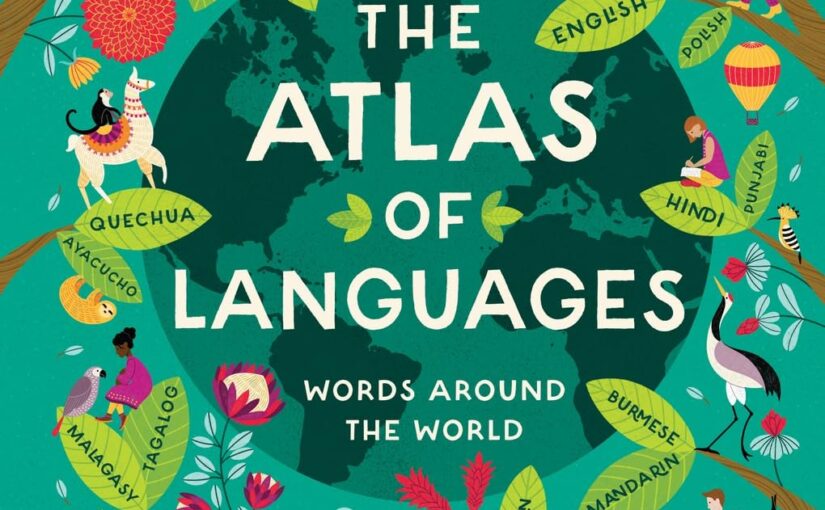
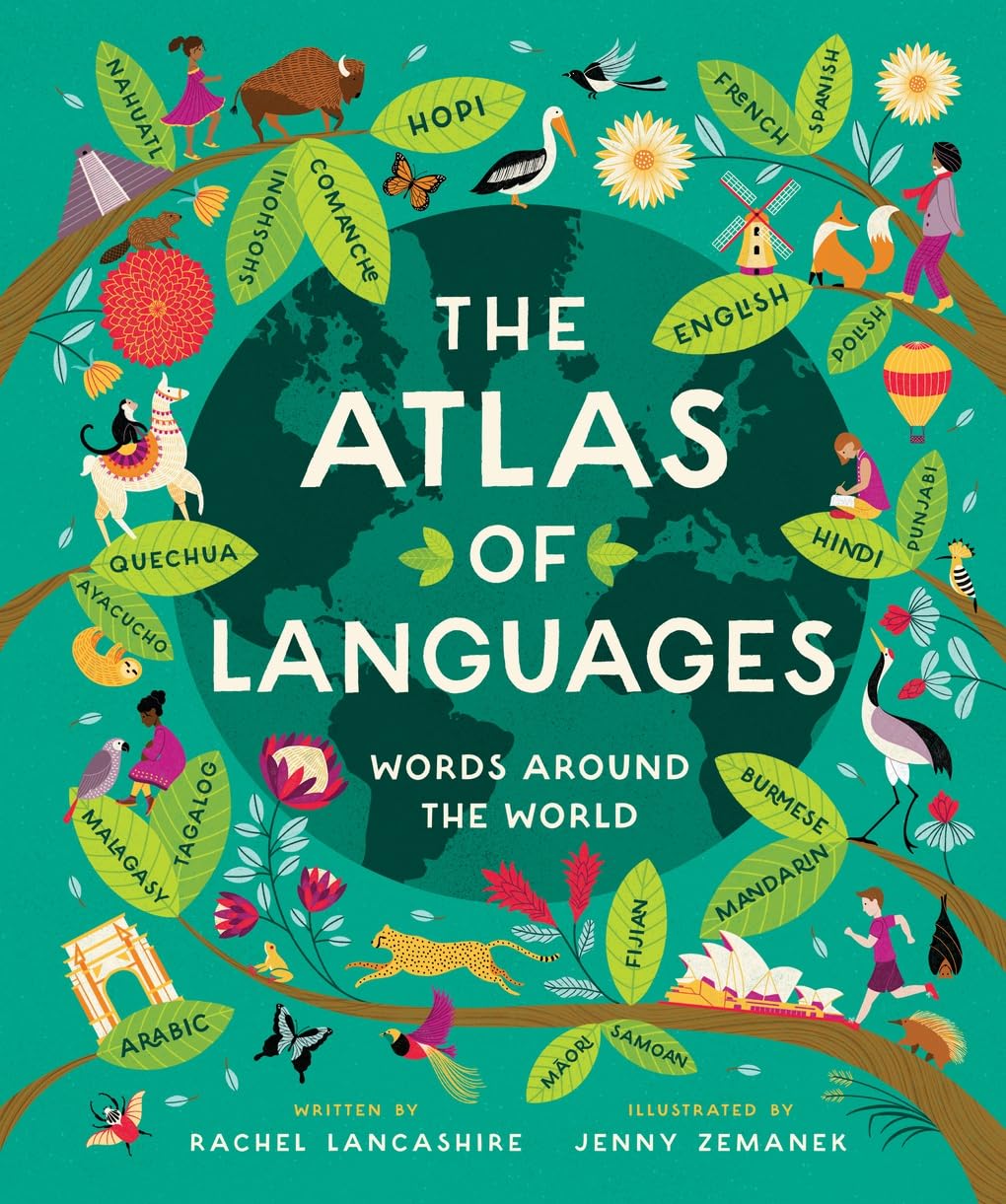
What’s the fastest-growing language in the United States? *Which language’s word for television is literally translated as “fool’s looking box?”**What language has the very flattering phrase that translates to, “even monkeys fall from trees,” to mean that everyone makes mistakes?*** The Atlas of Languages is loaded with those tidbits of information that younger ages and trivia fans love to share. The readable reference book is one that’s pretty rare, especially outside of the Nat Geo Kids Venn Diagram. That uncommon field is even rarer if it’s regarding a topic that is not animal-based.
That’s what makes The Atlas of Languages: Words Around the World all the more amazing. It takes the very complex world of languages and plots them out via maps of the continents and a tree that visualizes the languages in question. Each region introduces itself by the region, like Asia or Europe, and its map, with the countries that make up the continents separated by lines. There’s a pictograph of the region for things that are associated with it, like pandas, camels, hot air balloons, world wonders or archaeological sites. In those rare instances where the territory is disputed, there’s a dotted instead of a solid line.
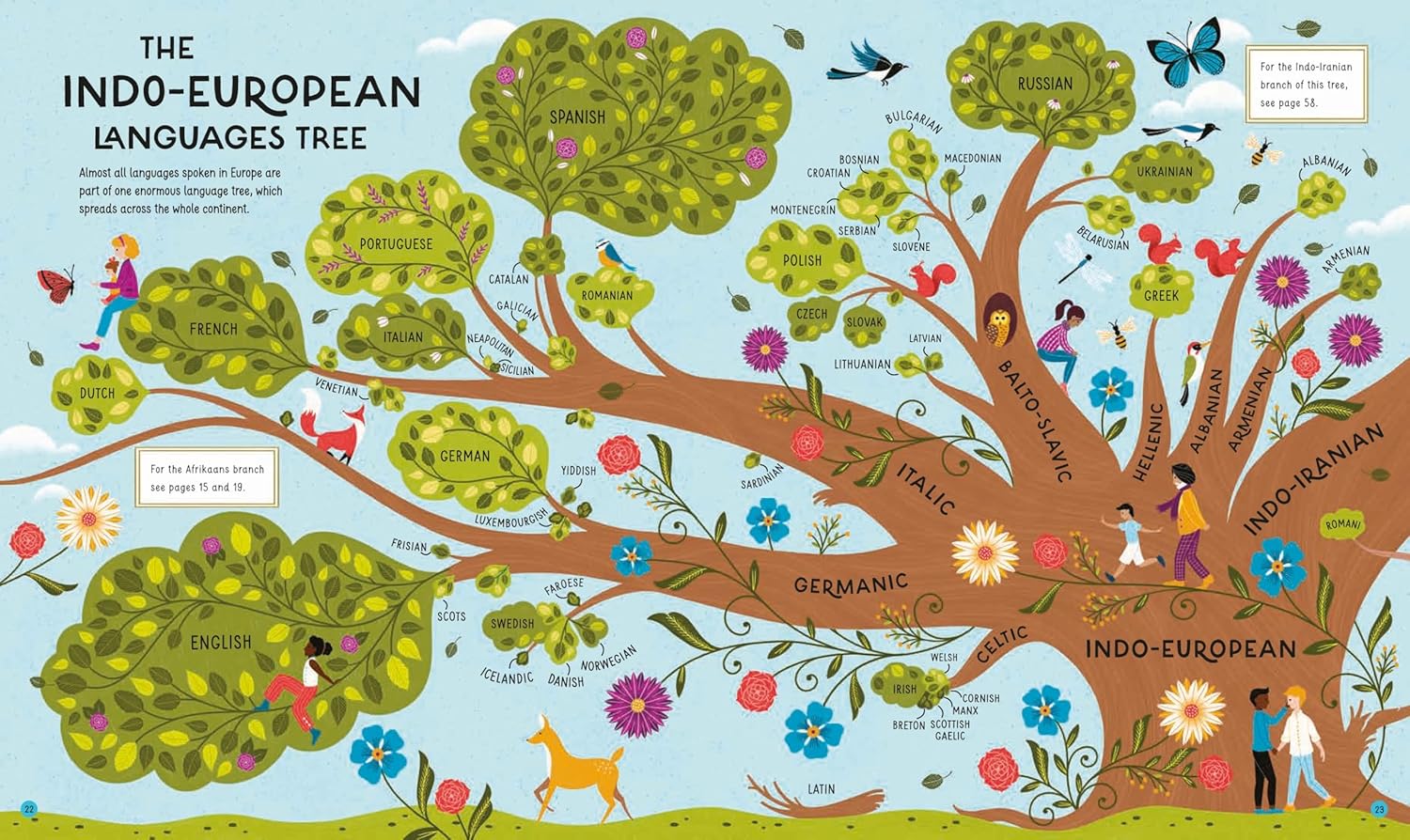
The language trees, unless you study linguistics or anthropology, are a little confusing at first. The Afro-Asiatic has about 500 million people in its language path that comprises around 400 languages. Readers will see a large illustration of the tree that takes place over two pages. When they turn that second page they will see the major languages spoken in that region, the specific country it’s spoken in, how many people speak it and a paragraph about that language.
This is where the magic of fabulously constructed paragraphs with solid information is partnered with a variety of colors and illustrations. The regional pages are color-coded so that young readers don’t get overwhelmed. The blurbs are broken up by borders, graphics, headers and illustrations. This also accomplishes the ability of young readers to lock in to the pages and not tune out, despite a massive amount of information.
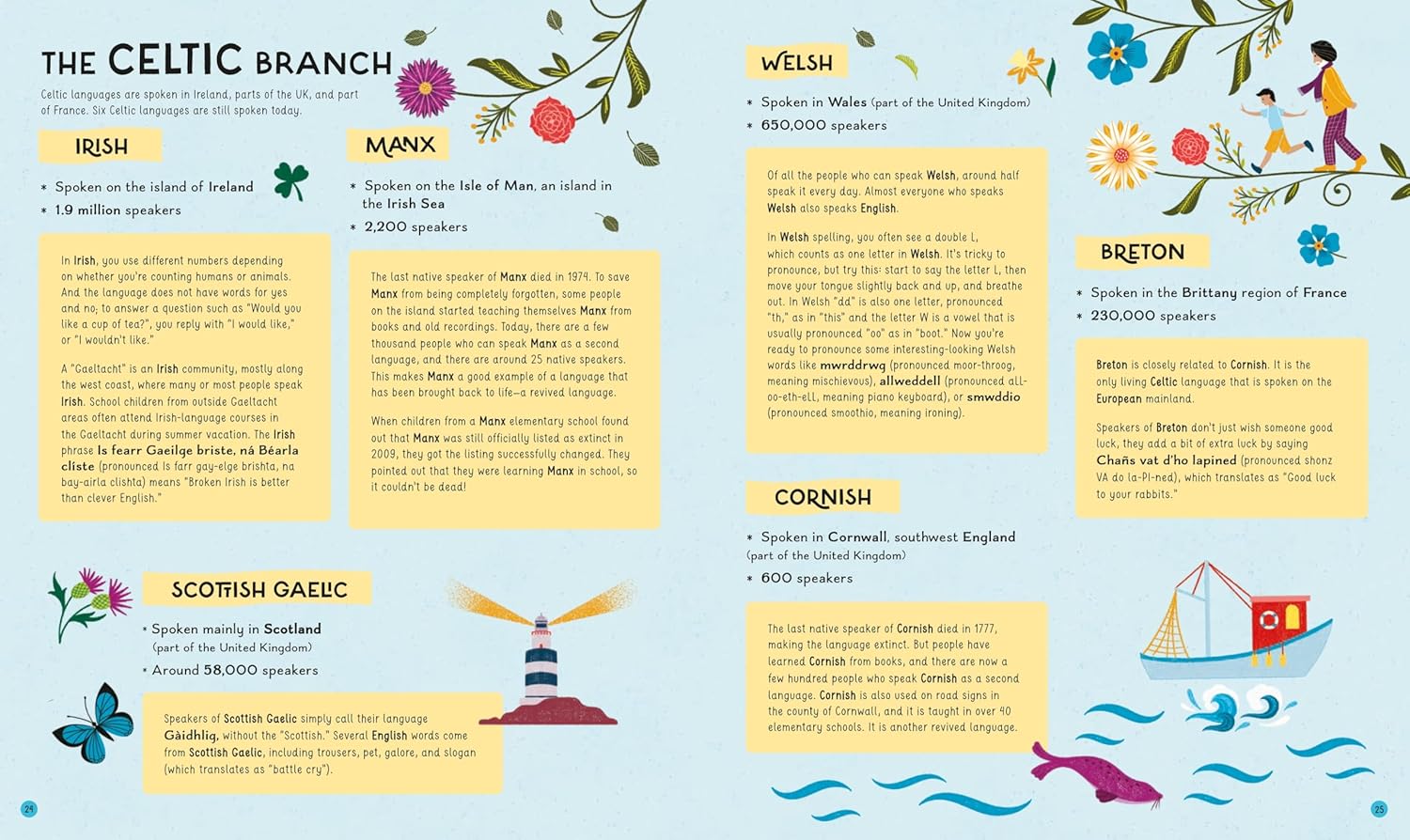
The Atlas of Languages: Words Around the World easily passes the potato chip or cat-video test. This is our informal cat-driven barometer to determine how interesting a young reader will find the reference content. If they’ll look at a page and easily shut the book then it fails the cat-video test. However, if they engage with one page and go to another one, and keep going, then the book passes the cat-video test with flying colors.
The final couple of pages in the book are devoted to sign languages and how they stack up across the world. Chinese sign langage is the leader with 4.2 million users, and is a bit ironic considering that there is no “Chinese language.” There are pages devoted to top 10 lists and other superlatives, as well as, a glossary and index. This is a great reference book for those upper-elementary through high school students who have their first essays, or need an extra punch in their high-end research papers. Those in the older end won’t get as much knowledge, but it will contribute to a wide range of sources or languages that they can compare their topic to.
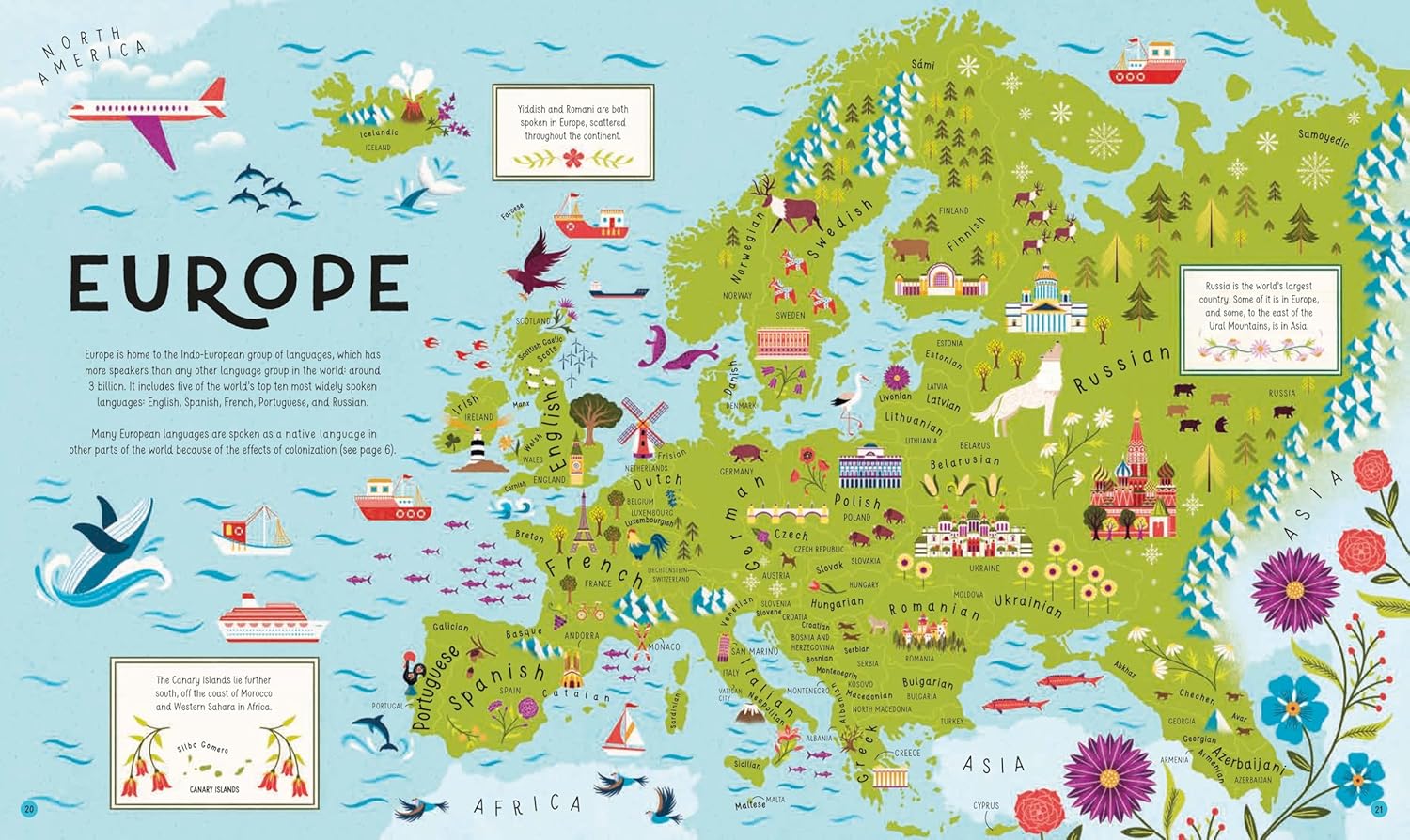
All of this takes me back to when I was teaching 5th grade and students needed to source facts. The smart kids were quick to find books with glossaries and indexes that allowed them to cover their topics quickly. I was also reminded of the time I was tending bar in Nottingham and one particularly surly customer came in yammering something odd. I thought he was really, really drunk, but he was actually speaking Gaelic. One of my co-workers happened to speak a little bit of it and got him sorted out. The customer just wanted a black and tan, but was also quite perturbed about the fact that nobody in central England spoke Gaidhliq. However, since I read The Atlas of Languages, I know that it’s spoken by 58,000 people in Scotland, plus that one dude in Nottingham.
The Atlas of Languages: Words Around the World is by Rachel Lancashire with illustrations by Jenny Zemanek and is available on Abrams Books for Young Readers, an imprint of Abrams Books.
There are affiliate links in this post.
*The fastest growing language in the United States is Telugu. It’s the most widely spoken Dravidian language and is spoken b 96 million people in south central India. **Dinnilos-dicking-muktar is Romani for television, it’s also the largest minority language in the European Union.***Korean uses that phrase that essentially means “everyone makes mistakes.”


 Facebook
 Twitter
 Youtube