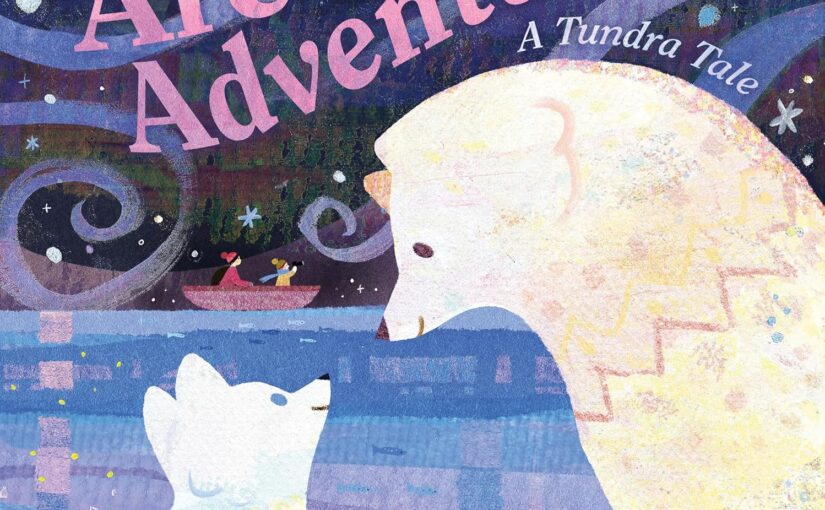
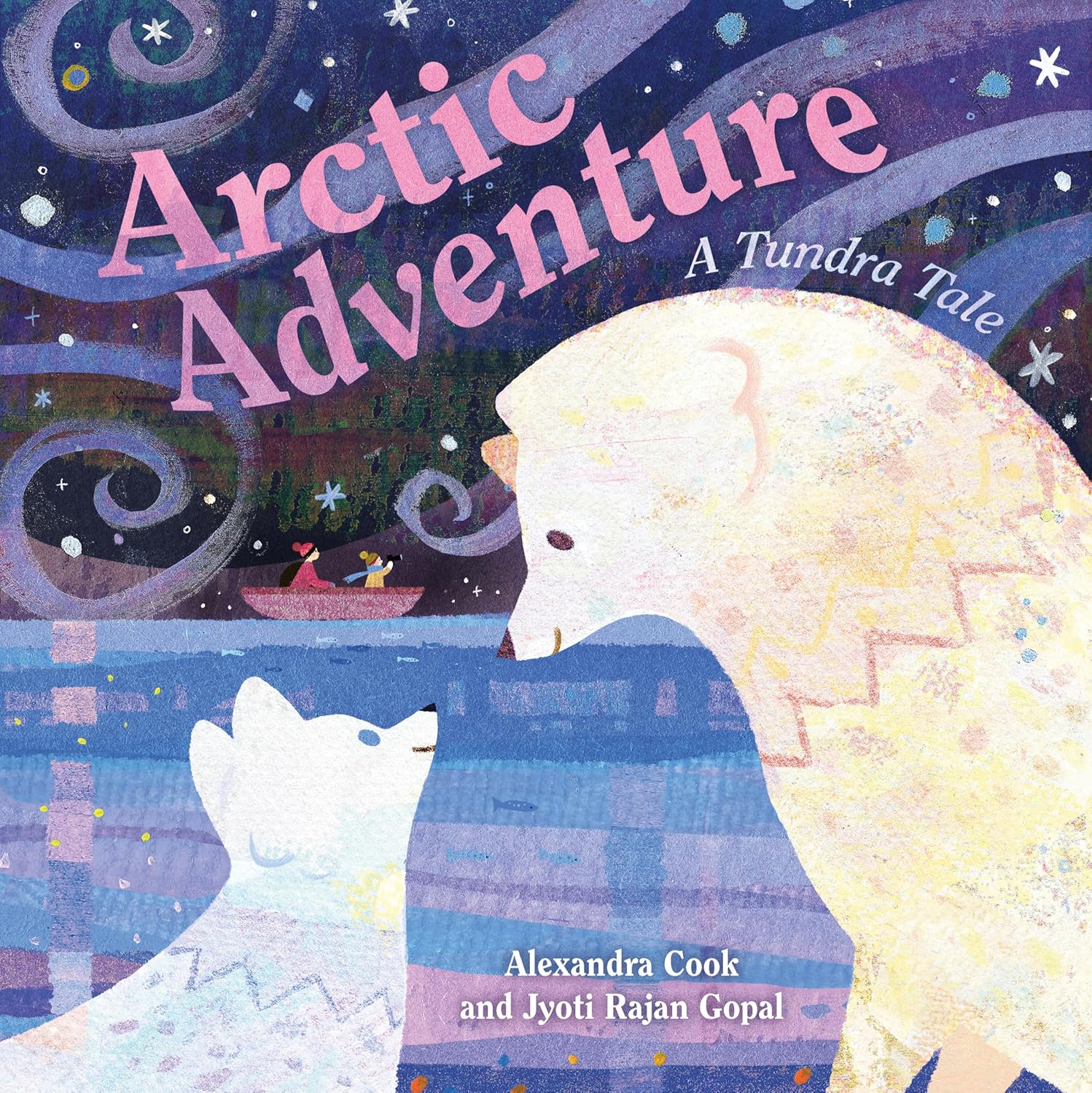
That’s a handful of alliterations in that short title, aren’t they? And while young readers might not appreciate its clever wordplay, they will immediately notice the glossy aspects to the book’s cover. The arctic fox is looking at its kit, while a mother and her daughter are in a boat in the horizon. In the background are whirling colors that older readers will associate with the aurora borealis. Younger readers might not know that fascinating light show, but will associate the pattern with something akin to Willy Wonka and be immediately curious about the show. That magic will continue as kids open Arctic Adventure. They’ll fall into wanderlust and become the armchair traveler that great illustrated books can help kids embark on.
As soon as you turn the book’s cover you’re greeted by a bright pink page. The flyleaf, as I just learned, is that blank page that allows readers to ‘enter’ into the world of the book. In this case, the bright pink and its complete opposite hue of everything else in the book draws you in. The half-title page, which has the book’s title, subtitle, authors and publishers, is next. This illustrated page is the first example of why the book works so well. The mammoth scale of the arctic is shown as the two foxes are dwarfed by various ice floe.
Don’t be alarmed when you open the body of the book. It’s free verse poetry. This is the non-rhyming style of poetry that sarcastic adults associate with drum circles and under-employed college roommates. It can also be a non-threatening, peaceful way to tell a story. One can easily imagine an engaging, yet sedate voice like Mr. Rogers reading Arctic Adventure aloud, and you’d love every second of it.
A couple of the pages don’t have any words on it at all. There are some pages that just have a stanza. However, young readers, don’t concern yourself about the number of words or way in which the text is presented. Instead, just follow along as Arctic Adventure is read aloud to you. You’ll marvel at the subtle shades of differences between the purple, blue and black that make up the majority of the Svalbard landscape.
Svalbard is a Norwegian archipelago between its mother country and the North Pole, in the Arctic Circle. Arctic Adventure does a great job of illustrating what your mind’s eye thinks the area looks like. The big landscapes allow any organic matter to look as small as it needs to be in comparison. In the greater perspective of the frozen tundra they’re tiny and insignificant. However, to their mother, they’re the entire world; and when one of them goes missing the two different species find a common bond.
The text, or prose, in Arctic Adventure is succinct and dreamy. But, it also tells a narrative that provides young readers with enough information to follow a story and to fill in more details with their imagination. The mother fox and her kit scramble to the edge of a piece of ice to see a narwhal come up for air. Narwhals are some of the deepest-diving whales and their ‘tusk’ is actually a tooth that some females will develop, but is primarily a characteristic of males. There are eight animals that young readers will meet, with an information page in the back of the book.
The visual space created in the illustrations allows young readers to drift off and create their own back story. The blue sky’s contrast to the snow and the foxes as they chase birds who are trying to escape becoming dinner makes kids wonder what else is out there. As the young child and the kit find each other in the night, the two are surrounded by blackness. The wind is tossing around the snow and the white text with equal chaos. It’s not long before the two are reunited, allowing Arctic Adventure to shine with the sky night lights that are synonymous with the northern region.
Arctic Adventure has a very natural and organic flow to the story. It’s a great example of the right text that is paired with just the right art, in just the right way. The art and words volley and parry like best friends, alternating which one is going to take the spotlight. The end of the book has four pages of non-fiction that older readers can augment the story with, if it’s being read aloud. This is the rare illustrated book that makes you care about a biome, without concentrating on a problem that is impacting it. It does take a little poetic license (that is acknowledged in the Illustrator’s Note), but does so in a way that’s not over-the-top. Instead, it allows kids to marvel at the illustrations, think about the story and dream about the places they might go when they get older.
Arctic Adventure: A Tundra Tale is by Alexandra Cook with illustrations by Jyoti Rajan Gopal and is available on Feiwel and Friends, an imprint of Macmillan Kids.
There are affiliate links in this post.


 Facebook
 Twitter
 Youtube