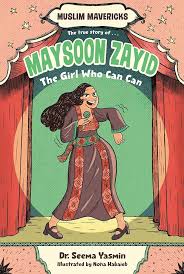
Muslim Mavericks is a new series of books by Salaam Reads. They’re non-fiction books that highlight inspirational Muslim figures. Maysoon Zayid: The Girl Who Can Can is an early chapter book. Zayid has Cerebral Palsy, a condition that impacts 10,000 people in the United States. The chapters in The Girl Who Can Can tell a story that’s inspirational, but its length and organization will impact who can enjoy the book and to what degree.
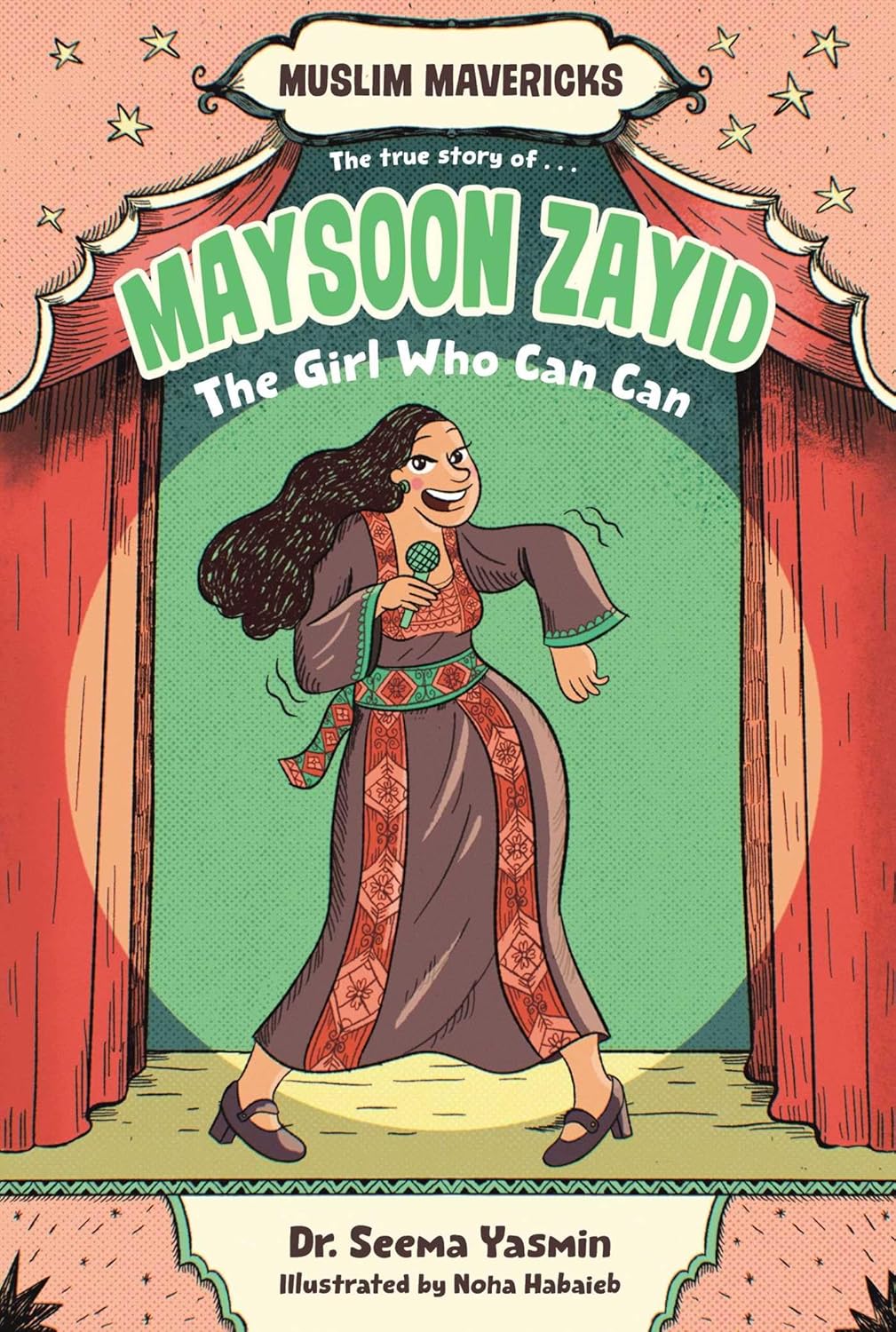
Maysoon Zayid, The Girl Who Can Can is an interesting book for many reasons. It fills a large void in representation. Young readers with Cerebral Palsy, or one of the ancillary conditions that would mimic its symptoms, like Muscular dystrophy or others, would find Zayid’s story motivational. Muslim young readers want to read about people like them. But, does this book cater towards the life of a Muslim, the aspect of overcoming adversity, or a catch-all life story?
The presentation
Muslim Mavericks: The True Story of Maysoon Zayid, The Girl Who Can Can is targeted at ages six through 10. The text has the same appearance as early reader chapter books. However, the length of the seven chapters varies, with some being twice as long as the one that preceded it. The vocabulary is too challenging for the younger audiences, which is the book’s intended audience. Those early elementary students will be able to read most of it, but the absence of illustrations on every page will intimidate them. If they’re reading it themselves, then the chapter length, unless they’re really committed, will frustrate them. If it’s being read aloud, then the chapter length is not dependable, and the content might not be the evergreen stuff that will please every audience.
The goal of the book
The Girl Who Can Can is the first in the Muslim Mavericks series. It meets that criterion very well because it’s an early reader chapter book about a Muslim. Zayid certainly broke boundaries by succeeding as a comedian and actress while living with Cerebral Palsy. Her two older sisters excelled at school. Her father was dismayed when the administration said the she had to attend a special school. She also wanted to dance and took lessons, but was never given the main stage routines to do. When she was allowed the opportunity to dance at a recital, her troupe commented that “it was nice of them to allow her to dance”.
She continues to struggle, with the eventual goal of appearing on her favorite soap opera, General Hospital. Eventually, she catches a break as an extra in a restaurant scene, which leads to other minor gigs and encourages her to go to comedy school. During her ascent she’s aware and proud of the fact that she’s a woman, Palestinian, a Muslim, from New Jersey and has Cerebral Palsey. It gives her a sense of accomplishment that she’s a combination of all of those things and succeeding in life on her on terms.
At its core, The Girl Who Can Can could’ve been an inspirational story about overcoming disabilities for all audiences. People should be proud of their heritage. The issue with this book, and the one that will impact its mass market acceptance starts on page 26.
The accuracy, or the bias
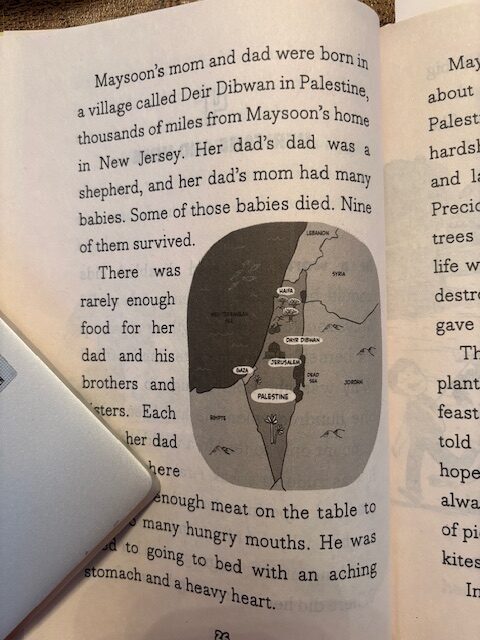
I am no cartographer, but the map on page 26 looks different than what I remember. It is not in the time of the British Mandate and it’s way past that of the Roman or Ottoman Empire. Yet, when I look at the map in the book of the Middle East, Palestine is huge, and Israel doesn’t exist. For context within the book, this is where the omnipresent narrator is explaining the area where Zayid’s family’s is from. Her father, and by default her, are very proud of their Palestinian heritage, and this chapter tells a little bit about their struggles.
Zayid is resilient and credits her strength to her family and its Palestinian roots. The familial strength and determination is a pivotal role in someone’s outlook. That’s a universal characteristic that anyone of faith or agnosticism can get behind.
However, I kept going back to that map. If there was text that preceded it, explaining that her grandfather grew up in Palestine and established his values in her father, that would make more sense. But it doesn’t. It puts a specific map whose existence is embraced, argued about, or highly politicized, and submits it as fact to young audiences. What about the maps that show Israel? We are not going down that rabbit hole… Instead, let’s simply look at 20 maps of the Middle East and see if there’s some level of uniformity. Bias in a children’s book is soft and insidious, especially if it’s cloaked in good intentions.
Is it entertaining?
The True Story of Maysoon Zayid is entertaining enough, but the map brief periods of constant Palestinian cheerleading will leave some audiences exhausted. It will make them tired in a Marsha, Marsha, Marsha way. It will also inspire others to read about the issue. It will preach to the choir for some audiences. For the mainstream audiences it’ll be a lightening rod that they avoid.
I suspect that’s not the goal of the Muslim Mavericks book series. It could be a series that introduces people who overcame bias, lived their life and practiced their religion. A feel-good book like, minus any intent of conversion, would be welcome under the umbrella any worthy person of any religion. The True Story of Maysoon Zayid: The Girl Who Can Can needed more time to cook. It would’ve benefitted by a more detailed look at her Muslim experiences and less of a wide net about the can-do spirit of Palestine. The end result is a pseudo book on Palestine and a comedienne with Cerebral Palsey who should’ve been the main focus of its inspiration.
Muslim Mavericks: The True Story of Maysoon Zayid, The Girl Who Can Can is by Dr. Seema Yasmin with illustrations by Noha Habaib and is available on Salaam Reads, an imprint of Simon & Schuster.
There are affiliate links in this post.


 Facebook
 Twitter
 Youtube