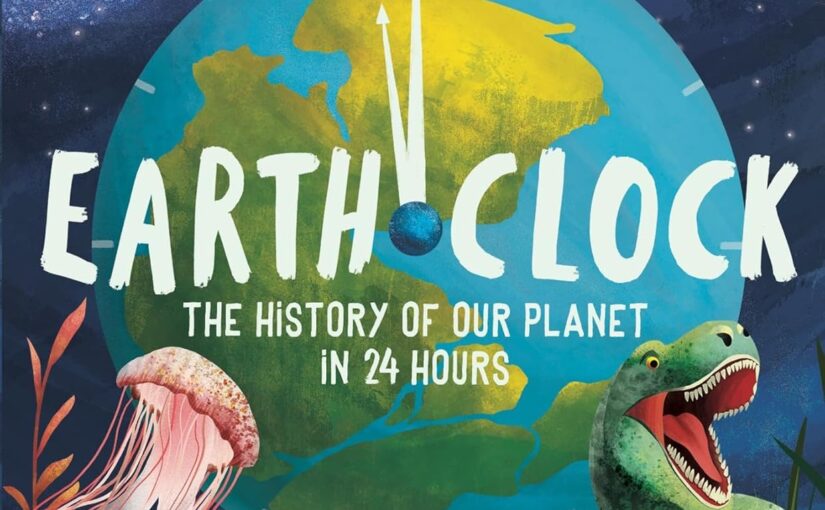
“It’s criminal how cheap this is”, I said when I was checking out. I was a Mojo Vinyl (no relation) looking through some albums when I found the debut, eponymous album from The Producers. I couldn’t believe it was only $5, not that I wanted to pay more. However, it’s always worth talking to the record store employees so that they know what you’re looking for. Speaking of criminal behavior, I can’t believe that Earth Clock: The History of Our Planet in 24 Hours is only $8.23 on Amazon. Also, it says that it was released in 2022? What book vortex was I engulfed in to miss this one?
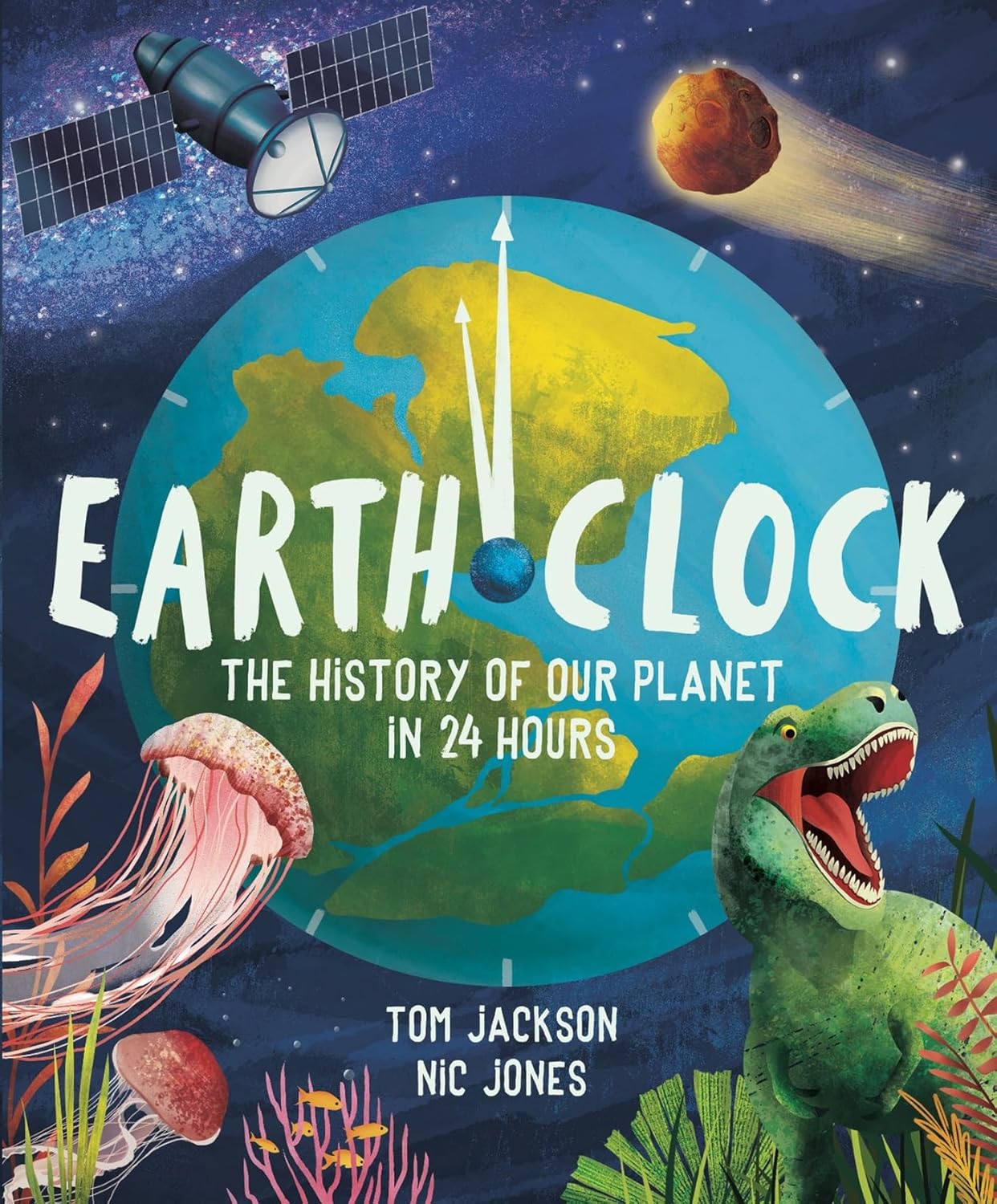
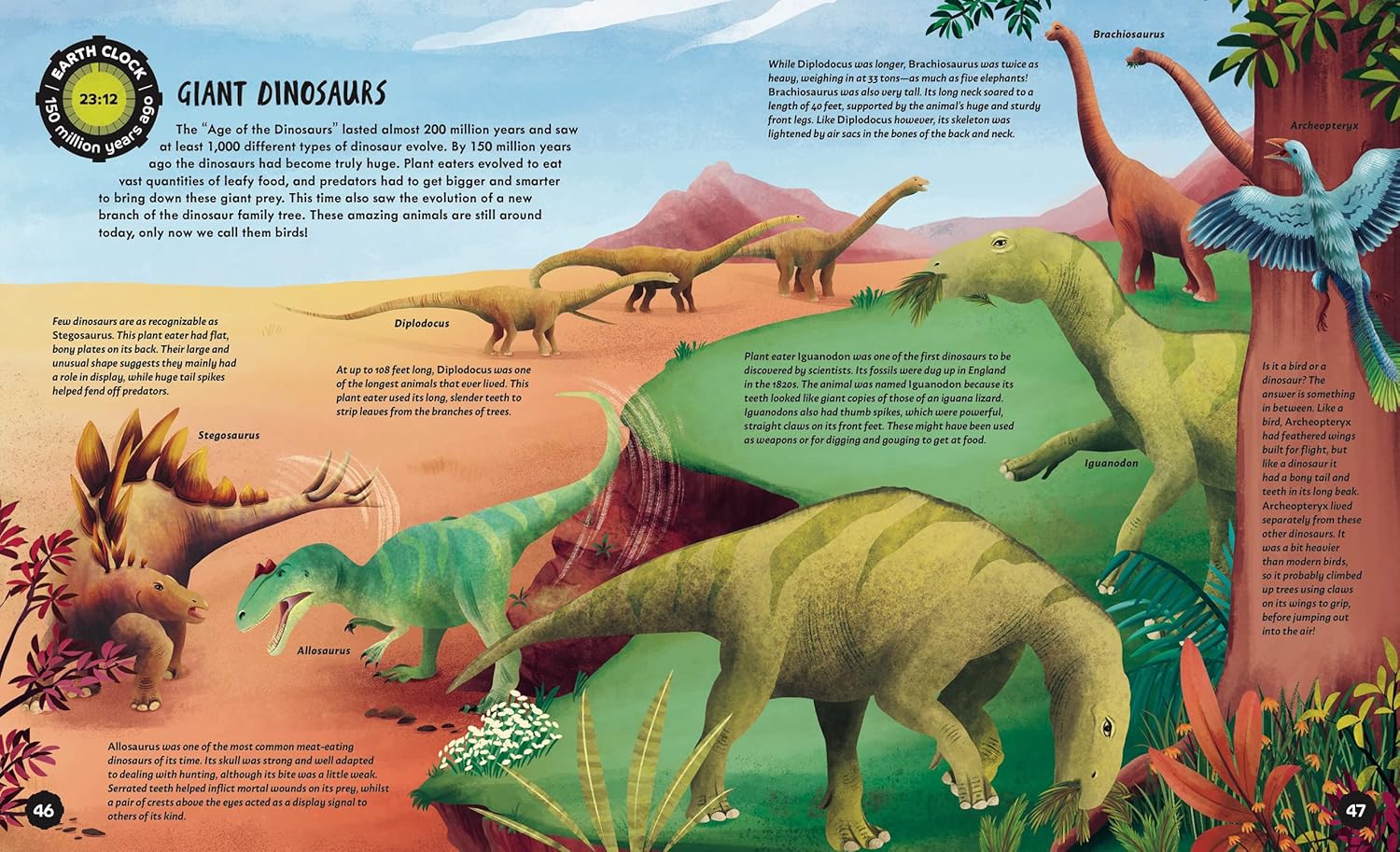
Moreover, Earth Clock is from two creators whose books I’ve previously enjoyed for numerous reasons. Nic Jones handles the illustrations in Earth Clock. Her style is detailed enough to make kids realize it’s a smart book, but keeps the art rounded enough not to be intimidating. This is especially helpful with the Earth gets old enough for meteor bombardments, complex life, dinosaurs and mammals. Jones has illustrated North Pole/South Pole, Night Time, and Above and Below. Those books have the same illustrated vibe as Earth Clock. It makes kids curious about science/nature topic, but it also allows the subject to be smart so that kids have something to strive for.
Author Tom Jackson is a kidlit, STEM author rock star whose books you or your kids have encountered at some point. If you’ve ever been to a big box, membership store, then you’ve seen the Ponderables book series. These books are reference books, but have a readability factor about them that few books have. The Periodic Table: A Visual Guide to the Elements is one of the best books on the elements that we’ve seen. It’s in our forever library and will remain there until we memorize the elements…so forever. He’s also written lots of the Basher Science books, namely ones on Artificial Intelligence, Engineering, Extreme Weather and more. He also wrote Earth Clock… probably in his sleep with his non-dominant hand, whilst solving a Rubik’s Cube in the other.
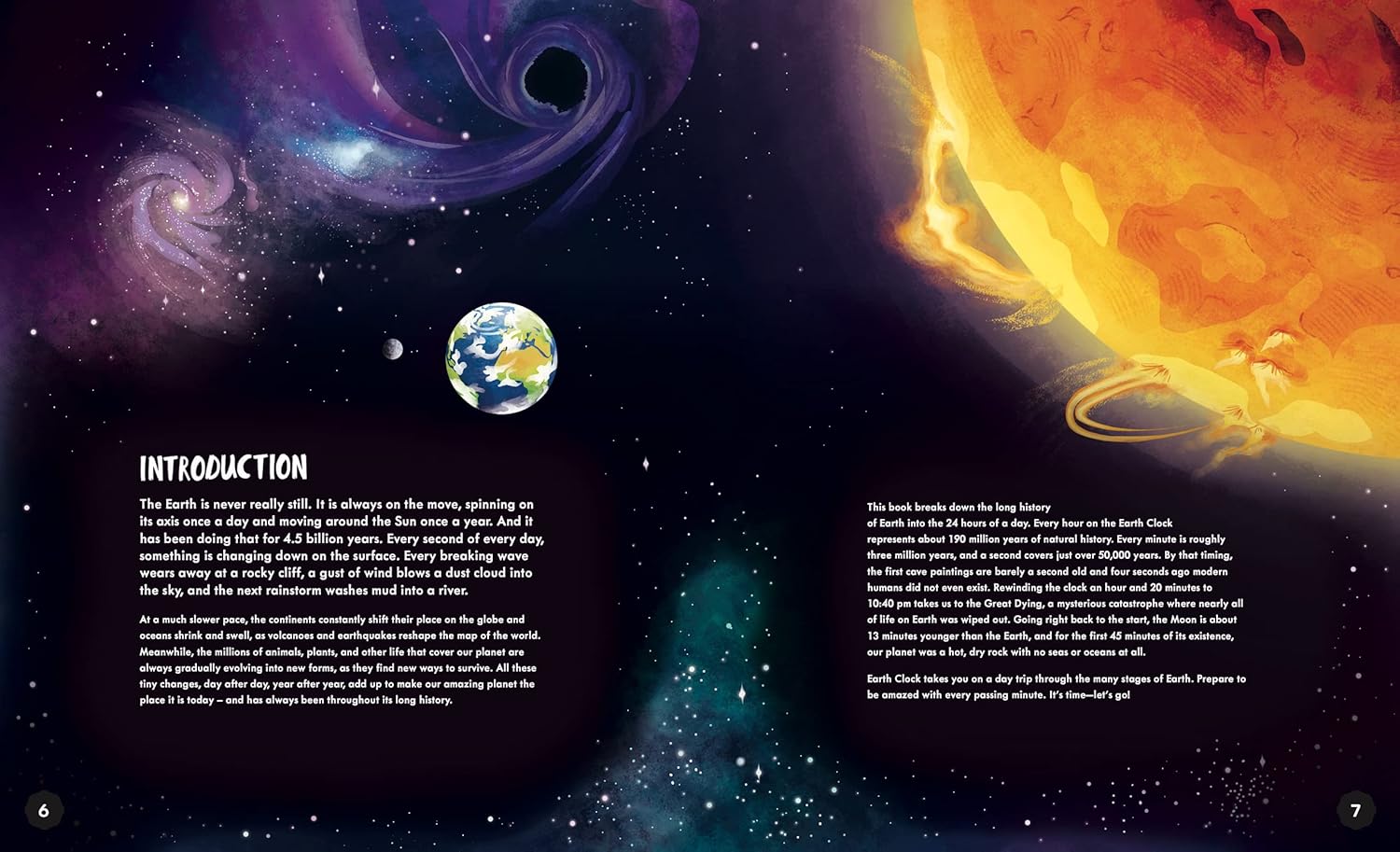
Earth Clock quickly establishes that the planet is always in motion. The book starts at midnight and continues for 24 hours, stopping at periods when landmark events happened. :13 seconds into the planet or about 4.5 billion years ago, the moon was created. Earth was hit by something massive, which displaced enough rock to create the moon. When that first happened, it was just over 22,000 kilometers from the planet; now it’s 384,000 away.
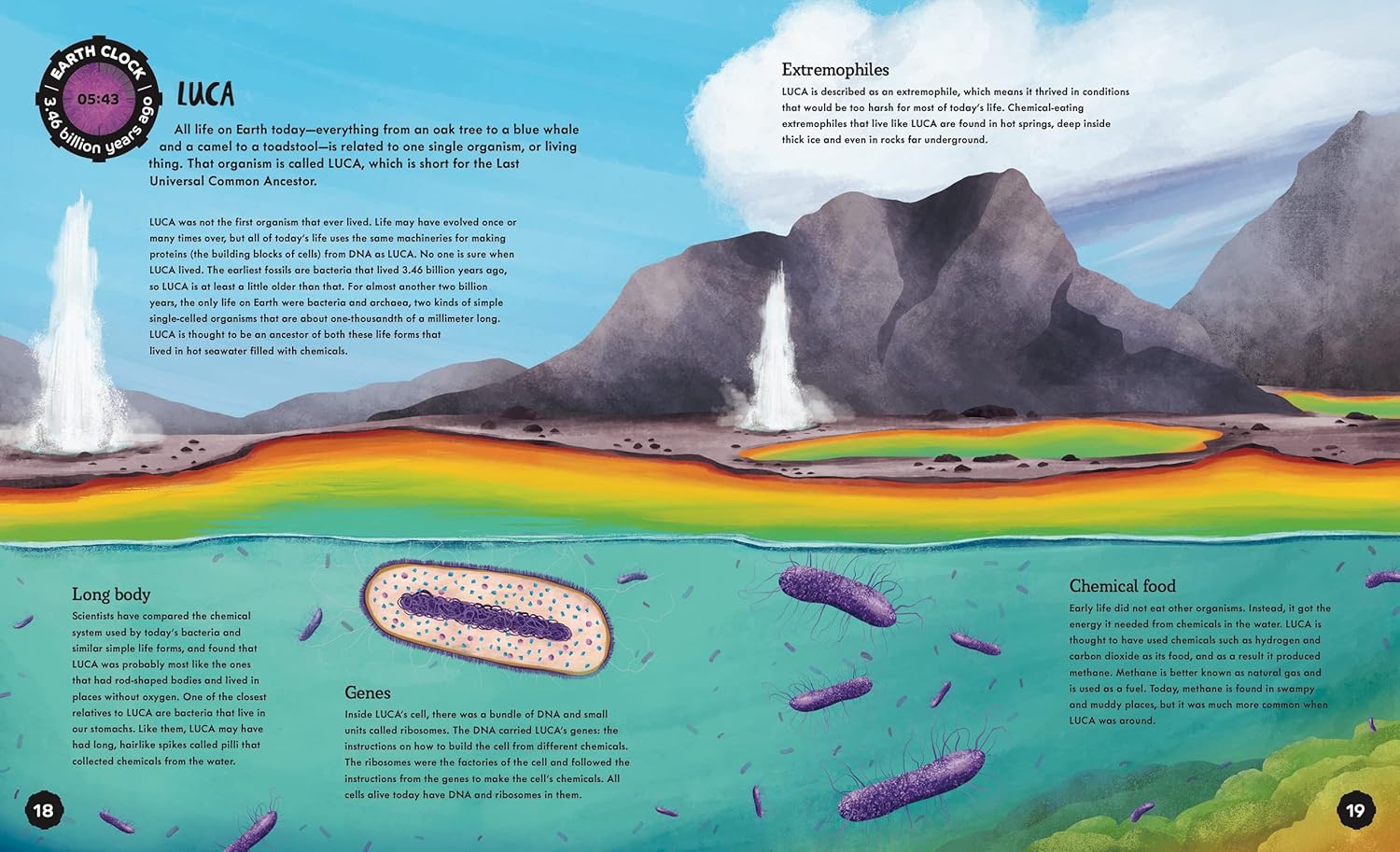
The Cambian Explosion is when living creatures really started to make it home. These were beady-eyed creatures who mainly had their eyes on the outer part of their heads, shells on their back, or long dangly tentacles. Three hundred million years later some proper amphibians joined the party. Eight million years later was The Great Dying. Because I’m an adult, and I saw dinosaurs, rocks and lava I simply presumed that this was the mass extinction, but it’s not. This was the eruption of the Siberian Traps, which was saw lava erupting from cracks in the Earth for 11,000 years. Obviously, Earth recovered and eight million years later, the dinosaurs were ruling the planet for about 170 million years until they saw that six-mile wide space rock hurtling towards Mexico.
Early humans didn’t arrive on the scene until 23: 59:32, but had more in common with an evolutionary link. At 23:59:59 those upright-walking beings began making tools, drawing on cave walls and formed a couple of social groups. It’s only at 23:59:59 that humans evolved something akin to what we see today. We are just one short strand of hair on a Sasquatch the size of your local high school.
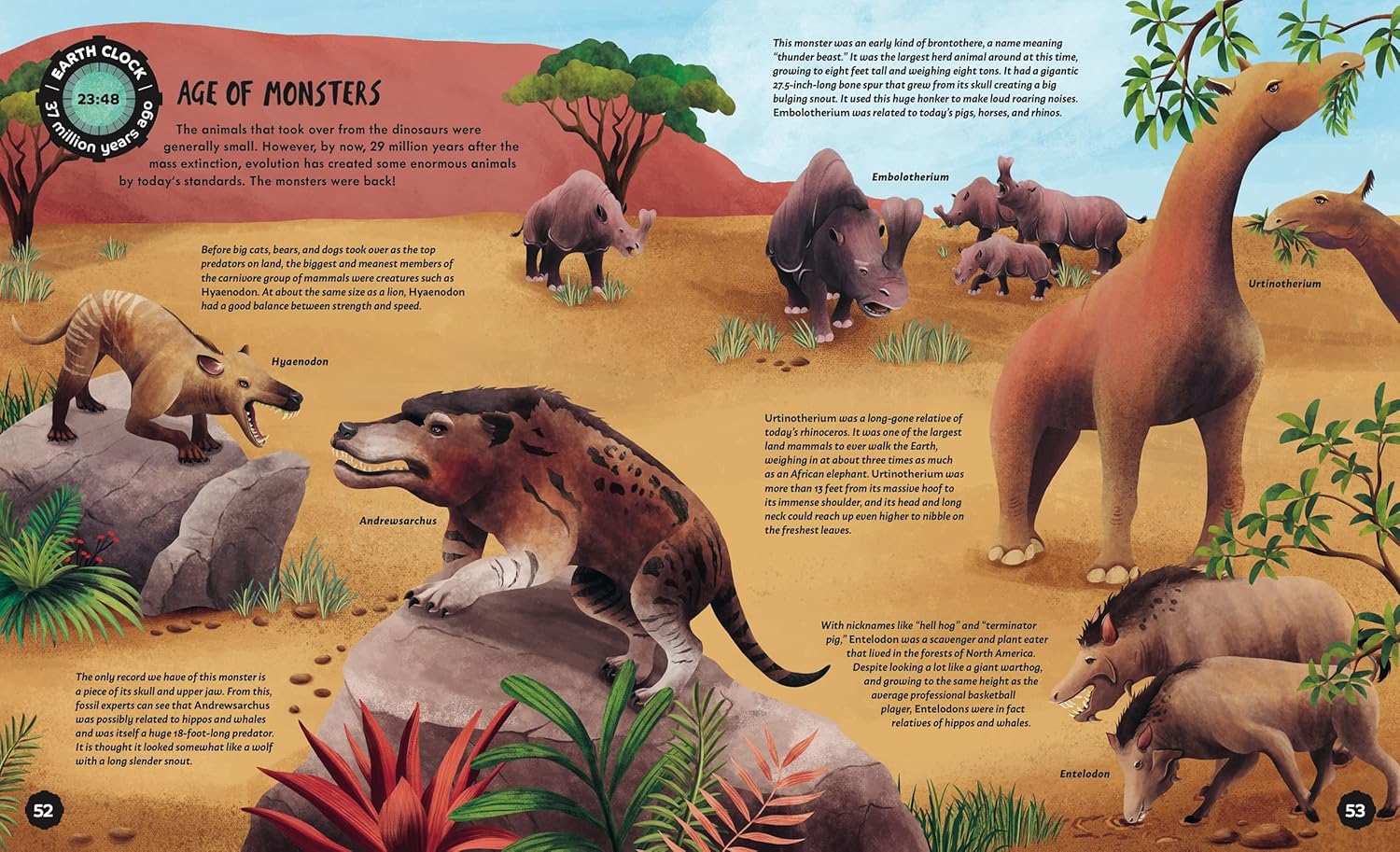
The text in Earth Clock is educational and has the elusive characteristic of asking questions and telling you the answer, without fully shutting the door on it changing in the future. Science is not static. It’s always changing, thinking of new reasons or possibilities as to why something happened. Even when the book gets to the point when humans start interacting with nature it leaves the impact of climate change open. It’s not alarmist, it simply states that things might evolve, but the planet will keep spinning.
It ends with a timeline written down with the eons, eras, periods, and where it sits on the ‘clock’, within the book. Currently, we’re in the quaternary period, which is in the Cenezoic era in the Phanerozoic eon. Earth Clock, come for the graphics, or the T-Rex and jellyfish on the cover, and stay for the tidbits of information that you’ll dazzle your friends and family with. It’s also really affordable on Amazon right now. There’s one copy of The Producers LP available for $99, (it’s not my copy), see what a steal that price was!
Earth Clock: The History of Our Planet in 24 Hours is by Tom Jackson with illustrations by Nic Jones and is available on Welbeck Children’s Books, an imprint of Welbeck Publishing Group.
There are affiliate links in this post.


 Facebook
 Twitter
 Youtube