
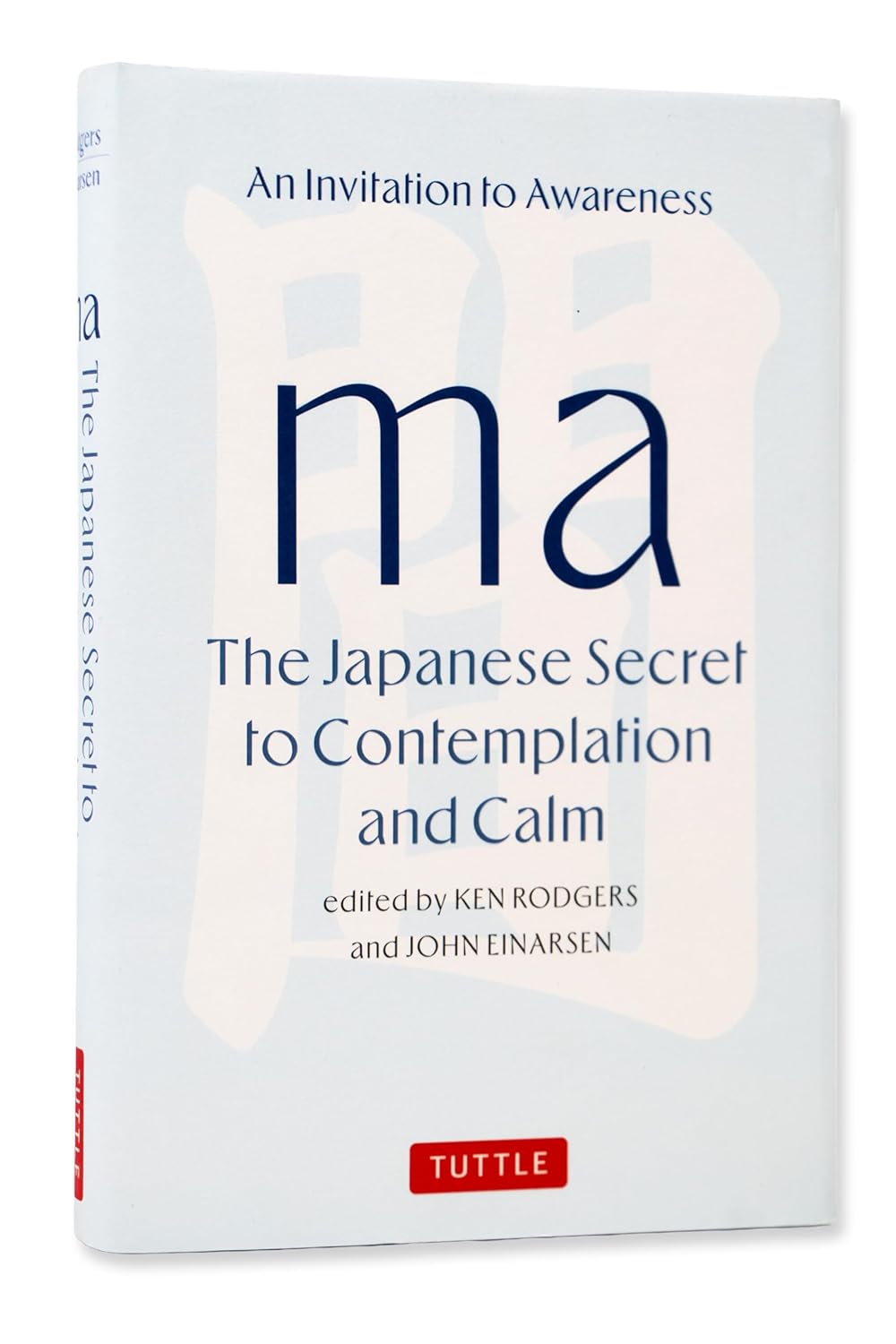
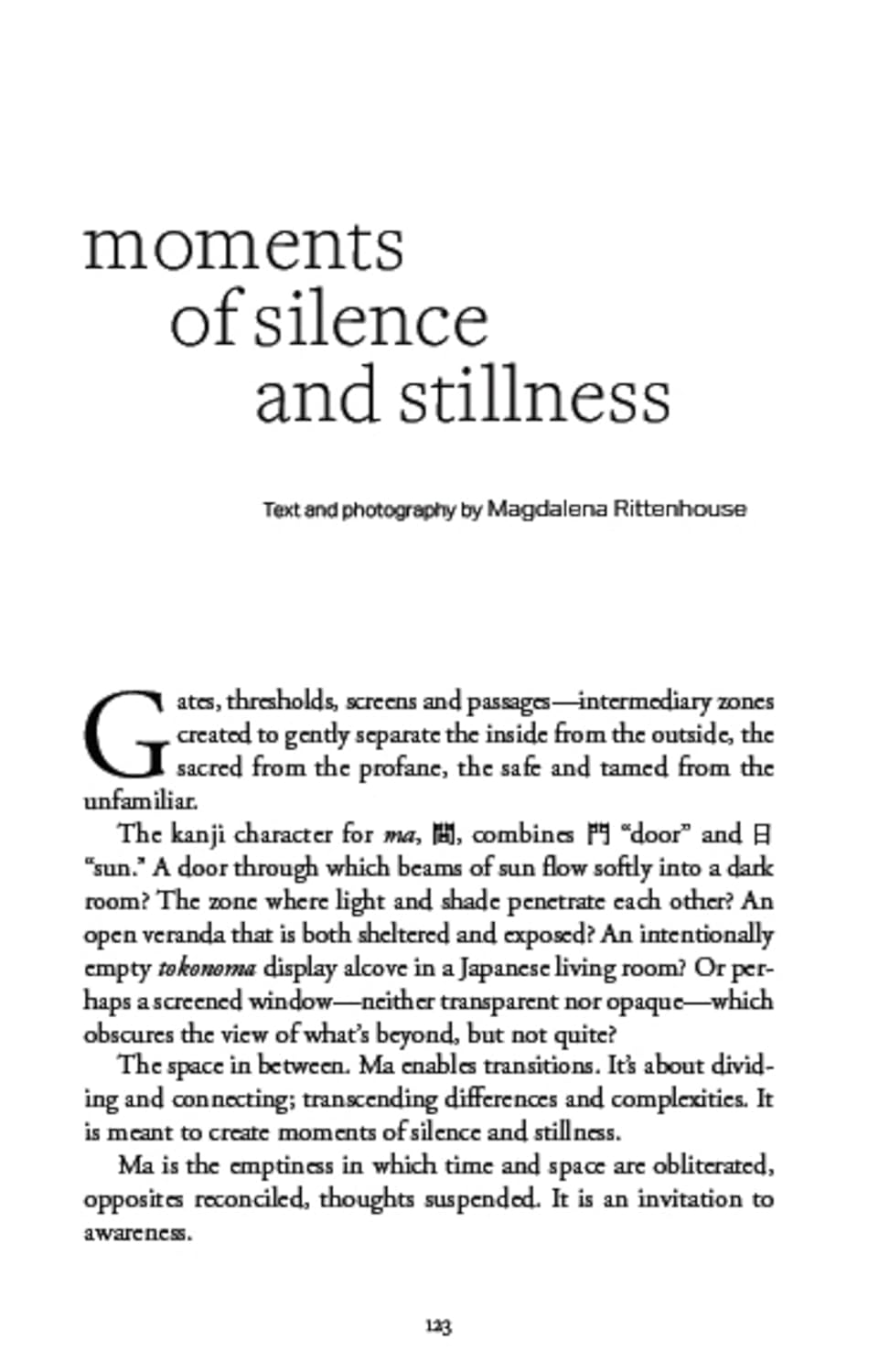
Tsundoku is the Japanese word for buying or collecting books, intending to read them later. In the meantime, they form paper based, scaled down mountains that range in colors and thickness. I use that word as more of an activity, or something I do, rather than an affliction. Ma is a much more subtle Japanese word. It can mean ‘negative space’, untapped potential, or any pause in life that you intentionally do. Ma: The Japanese Secret to Contemplation and Calm is a collection of 18 essays and photographs about the concept of what isn’t there.
The isn’t part can be anything. It can also be anywhere, and at anytime. How do you acknowledge something that isn’t there? And if it’s not there, doesn’t that mean that something is missing? A missing something means that there’s a void that needs to be filled. If you don’t notice that something isn’t there, doesn’t that just prove that you didn’t need it? Our mind might try to fill in those questions or add to those statements depending on our mood, culture or any number of external and internal factors.
Ma sounds like it’s in the Venn diagram of Zen, and I don’t subscribe to that, so I’m out. Now, hold on Sally. Ma is not a book on Buddhism whose intent is not to convert people to the religion. As with any book where Japan or another Asian country is the topic, there are aspects of Buddhism in the book. If you’re curious about Buddhism then Ma will speak to you as a primer on the religion. If you’re simply reading the book to be a literary or armchair tourist, that works too.
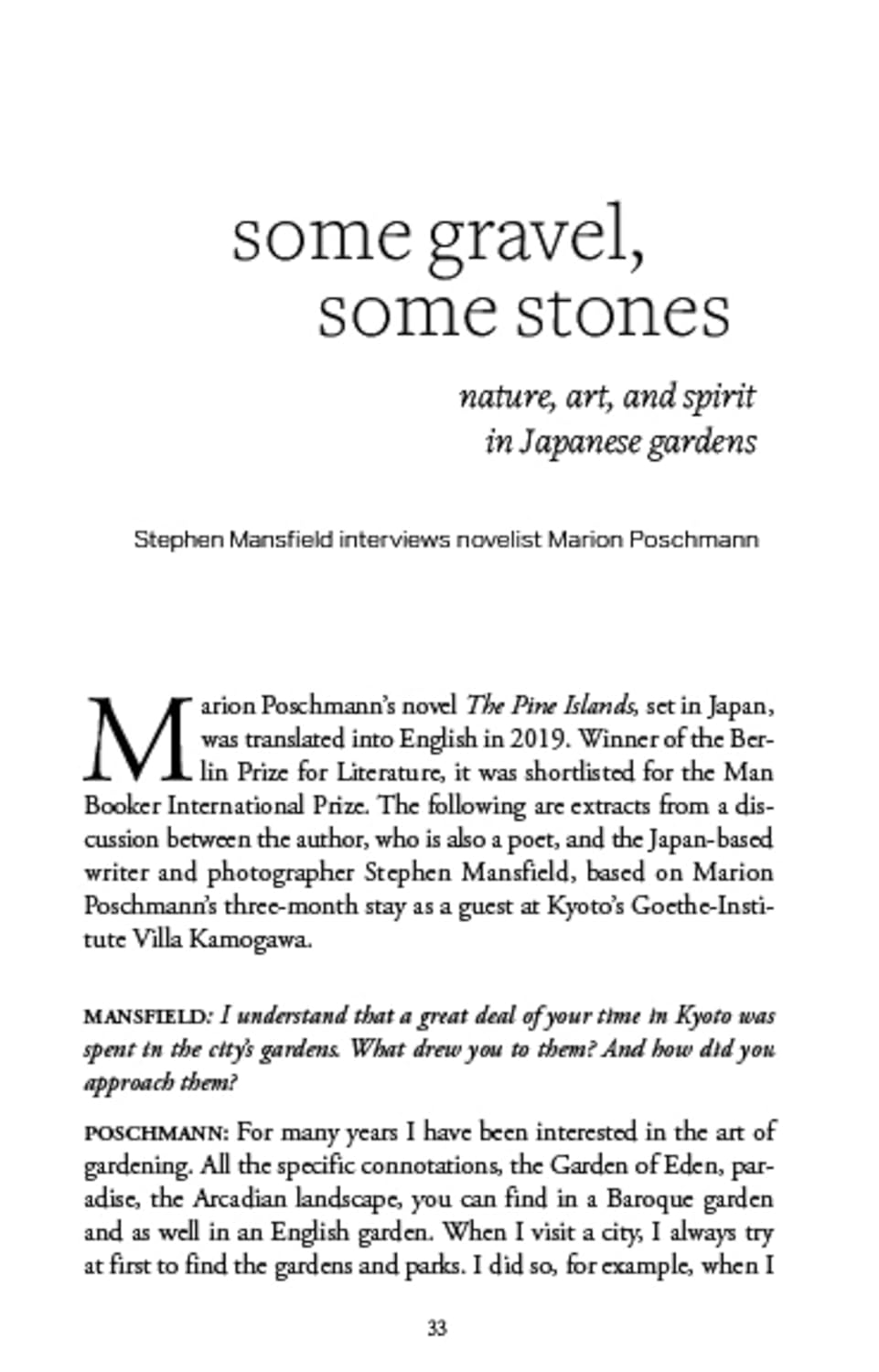
For us, the easiest way to think of Ma is appreciating what isn’t there. The easiest way for me to explain that to our students is to spend time away from your cell phone or social media. It’s the space between the mountain tops. It’s the silence that happens when the chorus isn’t singing. In a Japanese garden, it’s the pebbles that lay between trees and larger rocks. John Cage’s 4’33” was all about ma. Now that I have this lesson of ma behind me I can see it now.
Each musical venue has its own acoustic personality. Even when it’s silent, it’s not really quiet. Ma reminds us that just because something isn’t happening, it doesn’t mean that nothing is happening. Your something, or the something that was previously maintaining your attention might pause, but that’s it. The minutiae of life for everyone else, the animals and natural environment around you, keep on moving.
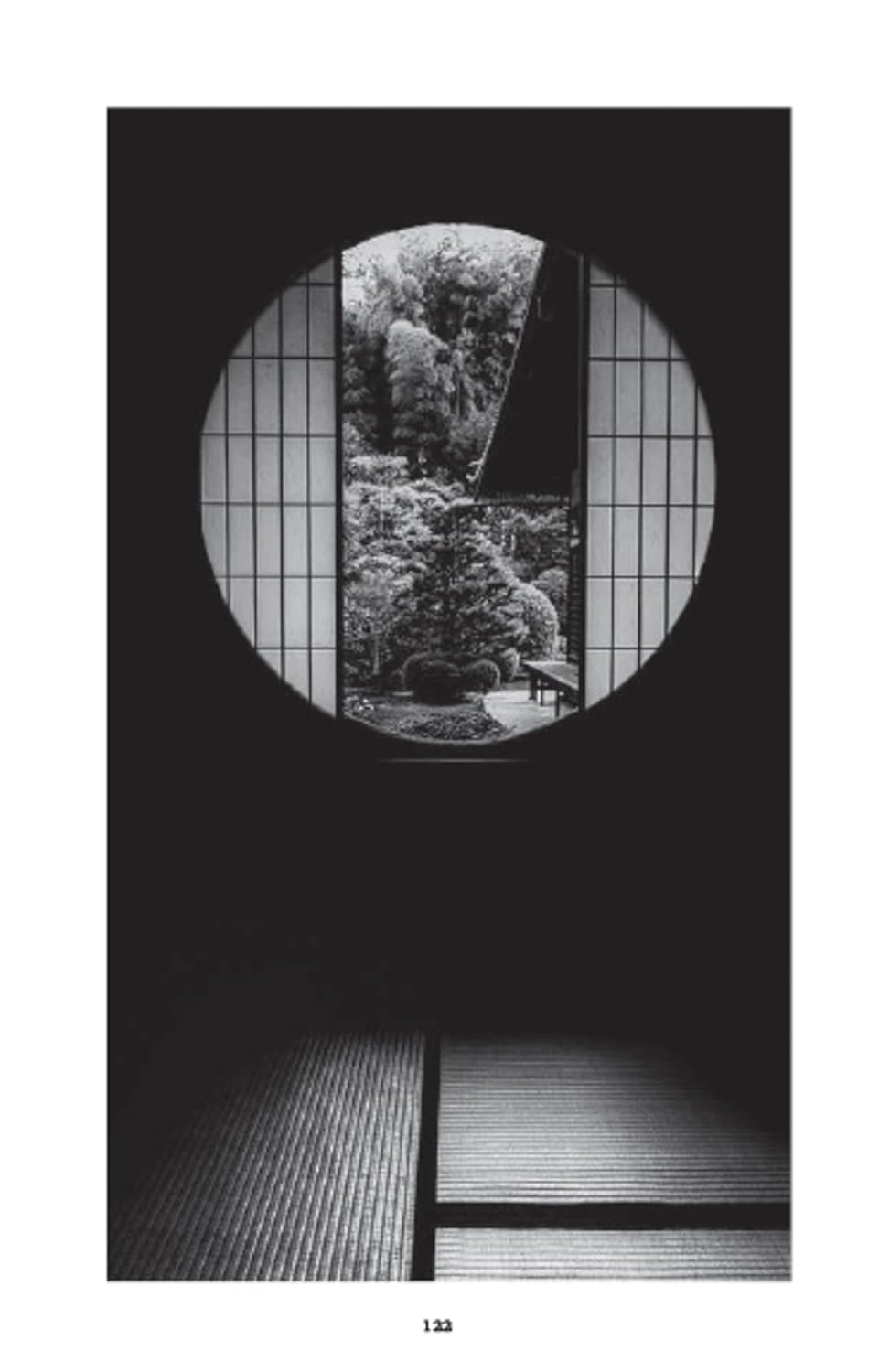
Ma is about learning to appreciate that time when the main idea may not be what you expected it to be. Look for the sky, in addition to the birds, mountains or trees when you look outside. When you’re removed from the equation, for whatever reason, do you enjoy the new situation or spend time worrying about it? Granted, sometime you need to worry about it, other times it won’t matter, and it might be the effect of things that are beyond your control. It’s about knowing exactly what the main thing to appreciate is. It is the tree in the photograph that’s adhering to the rule of thirds, thus allowing the things around it to shine.
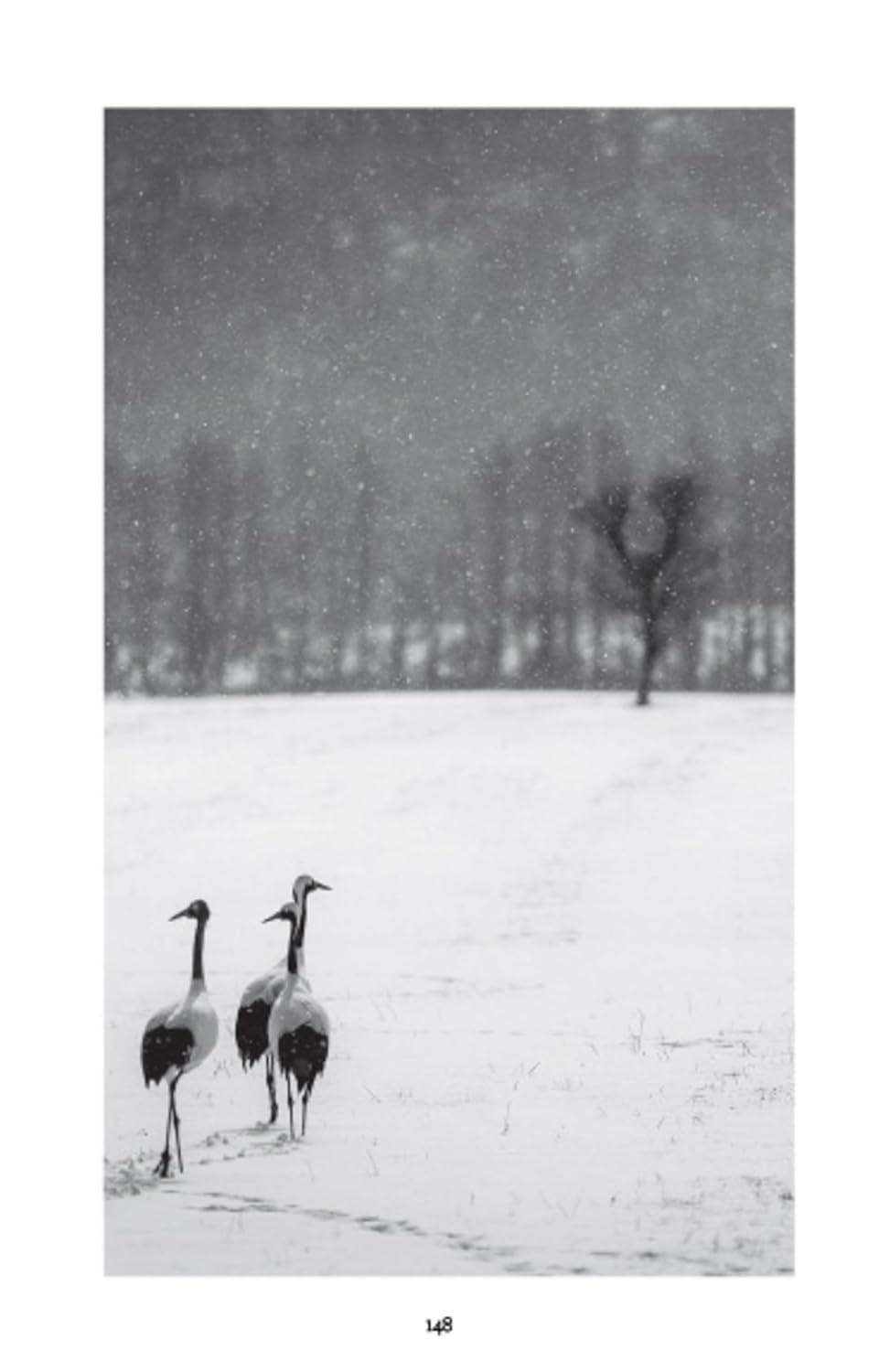
The photographs in Ma help you visualize what the words are putting forth. In that regard, Ma is a very good overview on that trait of Buddhism. It’s basic enough to pique curiosity, and has some deeper elements that will bore that same audience or motivate people with more knowledge to delve into the world of tea ceremonies. It is that chapter, the one on tea ceremonies that will be a Ma leap too far, leaving readers thumbing through to the next essay. The other 12 essays are palatable and provide readers insight into Japanese culture, a couple of vocabulary words for the language learners, and a gai-jin glance into what it’s like living there. You won’t accidentally fall into this book. You need to be mildly curious about one of the things in its wheelhouse. If that’s the case and you are, you’ll find a rewarding book that just might shift your paradigm in the right ways.
Ma: The Japanese Secret to Contemplation and Calm: An Invitation to Awareness is edited by Ken Rodgers and John Einarsen and available on Tuttle Publishing.
There are affiliate links in this post.


 Facebook
 Twitter
 Youtube