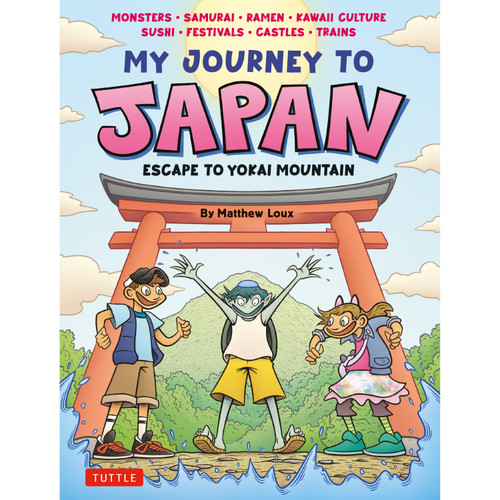
My Journey to Japan is an illustrated book like nothing you’ve seen before. Its format could be classed as an illustrated book, which readers associate with children’s books. However, once you open the book, it’s bigger and more detailed than one that’ll entertain elementary school ages. Those young ages will be attracted to the illustrations and the idea of traveling in Japan, but the amount of text might intimidate them. However, the book talks about things that kids love, like yokai, samurai, food, and adventure. My Journey to Japan: Escape to Yokai Mountain is a graphic novel-esque, illustrated book, travelogue that’s aimed at ages eight and older.
That’s a broad, amorphous category, but the description fits in a good way. My Journey to Japan is a book that’s attractive to elementary school audiences, but might be too young to read all of it. Middle school audiences will love the content, but might think that the presentation is too juvenile, ie, an illustrated book. High school audiences love all things Japan and will be able to follow the plot in My Journey to Japan, but might think of it as an illustrated book.
Once kids open My Journey to Japan: Escape to Yokai Mountain all but the youngest readers in that swath will be charmed by the book. There are illustrations that take up entire pages with blocks adding details and movement to the story. Older readers will appreciate the surreal aspects, like when the minogame appears. The minogame is an ancient turtle takes the book’s characters to outer space as it introduces the Ainu. There is a lot of education happening in the book. It’s fun education that happens in that order, which makes it effortless in both categories.
A set of twins are accompanying their dad on his business trip to Japan. It’s been a lifelong goal for the kids and they’re excited to explore things with their father. Unfortunately, on their first full day in Tokyo, he gets called into an emergency meeting. The kids are ordered to stay at the hotel. When they go down to the hotel lobby, one of the few approved areas for them to go, they see a kappa. Due to the kappa’s green skin they initially confuse him for a ninja turtle. Shimesu introduces himself and briefly explains what separates him from other yokai.
He briefly shows them some other yokai and convinces the two kids to go on a magical tour with him. A water vortex is summoned, allowing the trio to go to Osaka Castle and Shinto shrines. They can also attend a Matsuri festival, experience Japanese art and crafts, meet samurai, eat local food, and see more yokai.
Approximately every three pages the trio meets someone new or experiences something cool. Because of this, the illustrations are constantly in motion with new colors, shapes, humor and action. The text is what will surprise middle school ages and up. These are the ages who will want to read My Journey to Japan because it will help drive the book’s enjoyment to the next level. The text is very funny and matches the character’s personalities.
Shimesu is an engaging teen-surfer character, minus any lazy characteristics you’d think of someone like that. Red Oni is a giant red best that they encounter in the forest who isn’t how the twins think he would be. Like many Japanese and visitors to Japan, he likes kawaii things. His more introspective brother looks like him, but is gray, and teaches the kids about masks, lantern and puppets. The rokurokubi, the witches with the elastic necks, ambush the trio in the forest and demand noodles. They eat okonomiyaki, discover J-Pop, manga and the aforementioned Ainu. The Ainu are indigenous people who live in Hokkaido, Japan and were steadfast in their culture. While the other three islands embraced modern ways, the Ainu retained older traditions and lived off of the land. There’s only one page devoted to them in My Journey to Japan. However, their story, especially for those older readers who know a little about history, might entice people to read more about them.
Readers will also not expect the book to be as funny as it is. There are some jokes that genuinely produce laughter and other situations that simply make you grin. When the three are in the forest they meet Bill Sasquatch, a bigfoot from British Columbia. Bill, like many other humans in Japan, are there to study Japanese or teach English. He loves Japanese culture so the trio take the otaku-loving monster to Akihabara. Pay attention to the dialogue because the twins make reference to the stores “looking like dad’s office, that they’re not allowed in”. It’s funny because it’s true, and every page in the book has some manner of equally clever text.
All of this is why My Journey to Japan: Escape to Yokai Mountain works so well with so many audiences. It’s got graphic novel elements and has de facto chapters due to the fact that so many interests are covered. Even if readers don’t like one topic, it’ll still be interesting enough for them to sit tight, read on, and find the next thing. It’s not a reference book. It’s more of a curiosity book for audiences who have even a vague interest in anything Japan, which, in reality, could be anyone.
My Journey to Japan: Escape to Yokai Mountain is by Matthew Loux and is available on Tuttle Publishing.
There are affiliate links in this post.


 Facebook
 Twitter
 Youtube
