Double agent: an agent who pretends to be a spy for one country or organization while in fact acting on behalf of an enemy. The concept of a double agent makes my head spin. I understand who a spy is and what they do. A double agent gets a little tricky when it comes to fully comprehending who or what they’re spying on. They have to report to their handler in their home country, as well as their contact in the country they’re spying on. Additionally, they have liaisons in both countries and need to keep their cover identity intact. Failure to do so is almost certainly torture and death, plus all manner of pain their families and loved ones would be subject to. Longest prologue ever. Double Crossed: The WWII Spies Who Saved D-Day is the amazing, non-fiction account of D-Day and the duplicity that was needed in order for it to succeed.
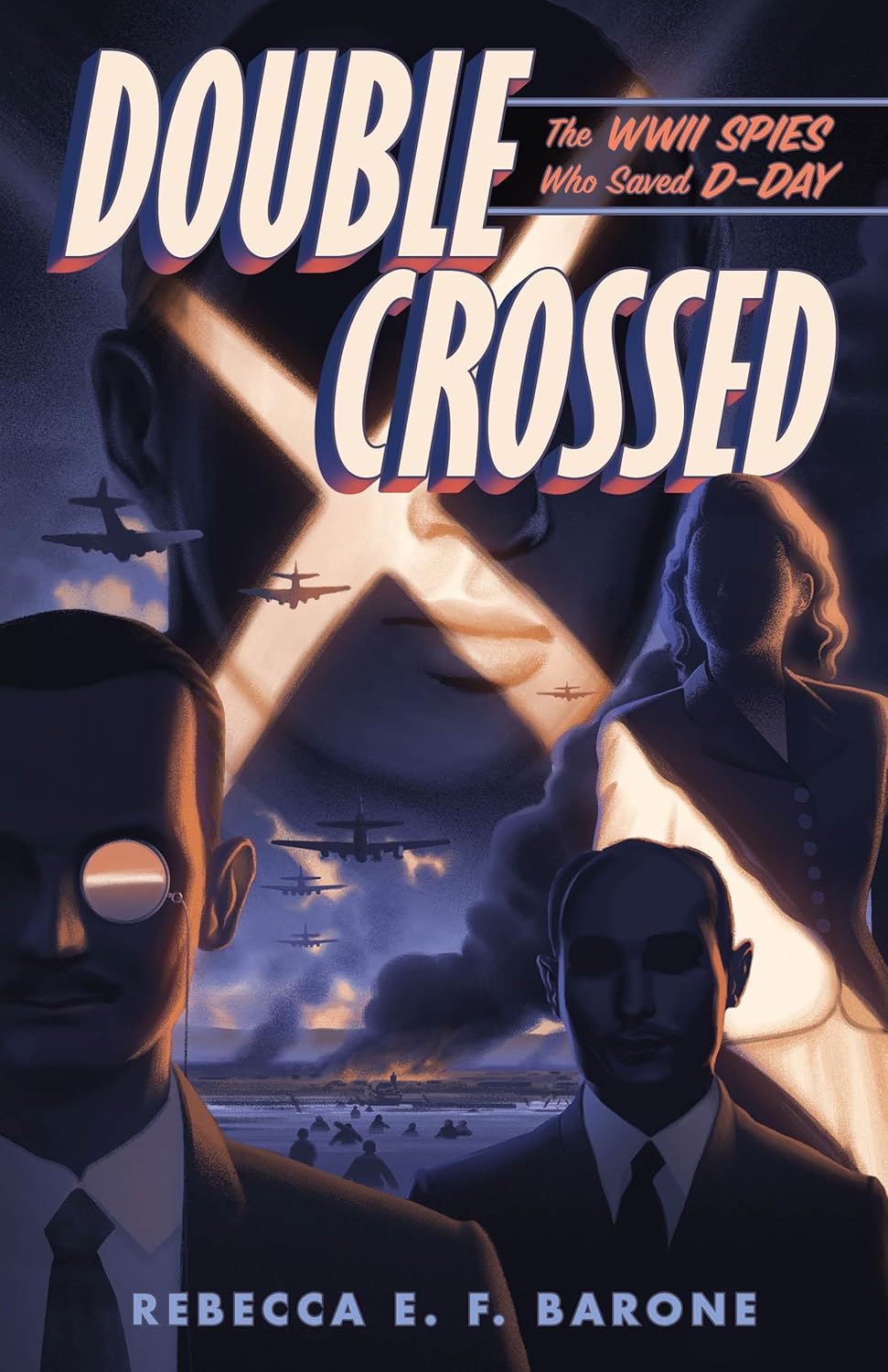
From that description, one would expect a book that’s written at a level intended for older, more mature readers. And to be clear, there are books like that on Garbo, Tricycle, Treasure or Artist, and the trickery that allowed D-Day to succeed. What makes Double Crossed work is that it’s written at an mglit level. However, will upper-elementary through lower-high school students enjoy, or want to read Double Cross: The WWII Spies Who Saved D-Day?
Double Crossed is very readable. It does more than simply having the quality of being able to be read. The book projects a non-intimidating, curious aura of “don’t you want to read me?” or “I know I’m a non-fiction book, and you usually don’t like things like me, but I’m different”. Double Crossed: The WWII Spies Who Saved D-Day is the good siren on the shore. Its soft song is going out to erstwhile scholars and intelligent people who would otherwise flail about in a tempest of doom, scrolling and ignorance.
Some middle school students might’ve heard about the inflatable tanks. A balloon, used to deceive the world’s most feared Army, and it worked? That must be included in some dopey YouTube Short that’s feeding an algorithm somewhere. They won’t know the details, nor, any specifics as to which country originated any of it. But the legend of balloon tanks, ghost troop movements and fake news were just half of the story in the story.
At the core of Double Crossed are the four main double agents who made it all happen. Dusko Popov was a Serbian spy, whose experience in Operation Fortitude is generally considered to be the inspiration for James Bond. Bond author, Sir Ian Flemming helped create an elite team of spies in the 30 Assault Unit, 30AU. That’s just an aside, Flemming doesn’t factor into the greater story of the XX system.
Popov was great friends with Johann Jebsen, an anti-Nazi German who had lots in common with the businessman. The two were fake fighting on the same side, all the while funneling information back to the British. Lily Sergueiev, a Russian, who fled to France after the revolution, became a German spy, and then offered herself to the British. She also loved her dog, and became quite persnickety to deal with, according to her handlers. There was also Juan Pujol Garcia. He was a Spaniard who tried three times to become a spy for the British, but was refused, so he became a German spy and then offered to share his intelligence with them.
One can see how this all could get a little confusing, yes? Author Rebecca E. F. Barone does a great job in weaving this potentially tricky tale into one that is an authentic page-turner for young audiences. Each chapter is around five pages in length with some of them having photographs. The pacing and delivery will drive the interest for those readers.
The chapters start with great hooks. Upper-elementary through middle school ages need a variety of introductions, even if they don’t realize why they need it. The chapters end in cliffhangers, and not in an annoying Batman 66 manner. They end in a way that eludes to the dangers around them and the greater consequences if they aren’t successful in their mission.
Young readers don’t need to know too much about WWII in order to enjoy Double Crossed. They need to be aware of the rapid victories the Nazi troops had in Europe in 1941-1942. They need to know that a sneak attack was crucial towards their success in stopping Hitler.
Double Crossed does a great job at setting that up too. Garbo, who was Garcia’s code name, was a farmer who had the greater vision to realize the extent of evil happening. There will still be some people who won’t read non-fiction. This is an example of well-paced storytelling that’s attractive to middle-grade audiences and older. It hammers home the same qualifications as a great all-age comic book. It’s presented at a level readers who dig into the book and feel respected by the level that its written. That fact can also apply to the younger readers who are perfectly capable of reading it, but don’t want to be associated with a ‘baby book’.
Double Crossed: The WWII Spies Who Saved D-Day is engrossing and gets readers turning the pages. It has amazing, heroic aspects that belie the fact that some young readers may only know the ‘balloon tank’ aspects of it. There is a photo of one of them, and they look very realistic, not at all what your mind’s eye in conjuring up. This is can’t-miss non-fiction that’s kid-friendly, and when something like this comes around in a package, you need to pay attention to it.
Double Crossed: The WWII Spies Who Saved D-Day is by Rebecca E. F. Barone and is available on Henry Holt Books for Young Readers, an imprint of Macmillan Books.
There are affiliate links in this post.


 Facebook
 Twitter
 Youtube