
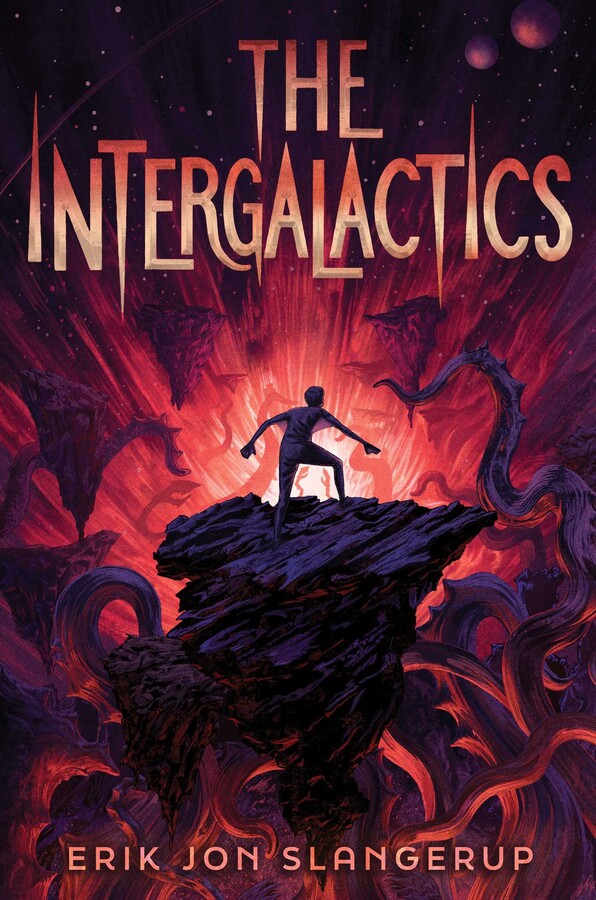
It’s tough to introduce worlds to audiences. What makes a young reader want to explore a new book with unknown characters? In my over simplified mind I view the world of authors as being similar to cartoonists. Assuming that all of the work is done under the same name, the content needs to have enough of the footprint that brought the audience, without being repetitive. I know, there are many adult authors who defy that mantra and flaunt the sheer volume of published or co-authored books. The Intergalactics is the first book in a series by Erik Jon Slangerup. It’s mglit that introduces young readers to aliens, who are surprisingly like us, despite being unique and in fantastical situations.
Mglit science fiction that really works- I mean the effortlessly enjoyable fare- is rare. All too often, science-fiction for mglit audiences has an agenda, cause, or some degree of a preachy element that hinders its enjoyment. The Intergalactics doesn’t have any of that. In their place is the much more universally accepted adventure, pacing, age-appropriate monsters, and enough friendship to make it seem genuine and not forced.
The book is very readable for mglit audiences. These are the readers who are as young as upper-elementary school through whatever age enjoys a good book. The latter cut-off is a moving target and could be in middle school or way past middle age, it just depends on the book and the reader. The Intergalactics has an ebb and flow in the manner that the chapters end. They set up the next chapter’s action at the cliffhangers or bait the hook for any of the mysteries that the characters are trying to solve.
It doesn’t get in the way of readers wanting to put the book down, and for young readers that temptation is greater than you remember. If a kid can find even the faintest excuse not to read or do work, they’ll jump at it. Reading shouldn’t be a chore, that’s why learning to love to read is so important. When a kid can read a book for entertainment they’ll be able to read for education much quicker than their counterparts. The chapters are broken up into very natural chunks that end with them wanting more.
Brinx and Jang are two best friends who have been grown in a laboratory. They’re part of a group of different aliens and monsters who are competing in a series of games. Each class needs to finish these games in order to go to a faraway planet that they’ve been told is a utopian place. Their team is a crew of disparate personalities who do somehow manage to beat the other teams and win a place on the ship. On the way to this utopian planet the ship crashes, killing some of the team and stranding the survivors on a planet of extremes.
All of the preceding happens relatively quickly in the scope of the book. By the one-sixth mark of The Intergalactics the team is stuck on the alien planet and fighting for their lives. The rapid progression of events is further proof of how efficient the book is in quickly laying out the action and getting to the point. See: mglit readers might not be the most patient bunch and will look for any reason to bail on a book.
The survivors of the crash have different personalities and must find a way to work together quickly, before the environment kills them. There are gorges, poisonous plants, deadly animals of all sizes and things that can kill them in any number of ways.
This is mglit, but there are elements of the book that are life and death. When characters from the ship die or get killed on the planet they really cease to be written about. Their death is written about in an age-appropriate way, in that it’s not graphic or gratuitous. However, the fact that a character ‘falls, never to be seen again’, is refreshing in that readers never see them again and the remaining characters don’t wake up from a dream or they fall on a ledge.
As the book’s plot progresses, the remaining crew dwindles until they become a team. They encounter things on the planet that look hostile, but aren’t, and vice versa. Survivors on the planet probably have their best interests at heart, but that’s unknown. Wait, The Intergalactics is a lesson book about teamwork in space? No, not really. It’s a science-fiction, mglit book on working together with people who don’t think or look like you? Meh, kind of. In its simplest description, The Intergalactics is an original science-fiction story that middle school kids won’t be averse to.
The quickest way to get kids to start reading is to not give them excuses that they’d use against it. All of the events move very quickly in the book. The characters are engaging, and kids will latch onto one of the personalities that mirror them. Kids have certainly never been stranded on an alien planet, but they’ve had things not go their way, and they’ll relate the two of them together. By the end of The Intergalactics readers will be thinking that this is a great team who should go on more adventures. Mild possible spoiler alert: the book ends in a way that allows the team to continue their exploits or fly off into the sunset.
They fly off into the sunset or in this case the rest of the solar system. Upper-elementary students through middle school will enjoy The Intergalactics. The book skews evenly between boys and girls, with neither of them having a valid reason not to read the book because it doesn’t have enough of them. Every major character in the book is a lab-grown creature. If a young reader is momentarily confused because they don’t know Vryken, it’s possible that they’re more likely to hang with the book because nobody is human. That possibility lends itself to more books with these characters, almost like a science-fiction-grounded City Spies.
The Intergalactics is by Erik Jon Slangerup and is available on Aladdin, an imprint of Simon & Schuster Children’s Publishing.
There are affiliate links in this post.


 Facebook
 Twitter
 Youtube