
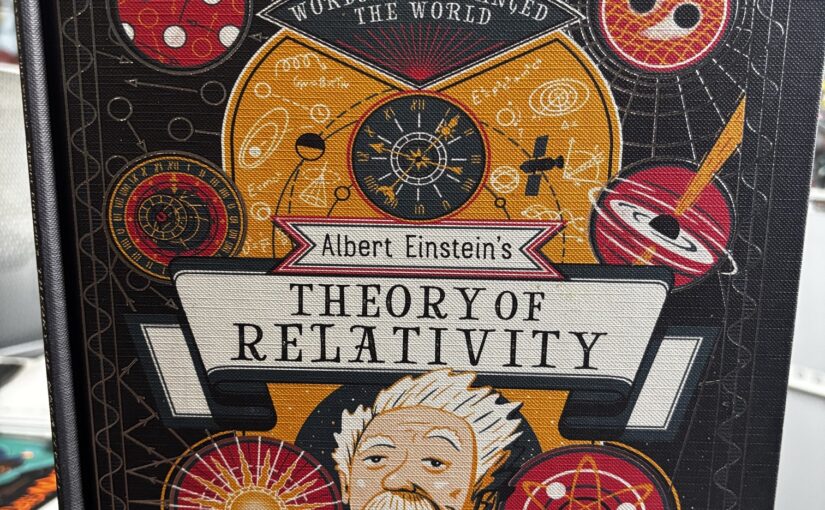
Come jump into the deep end of the pool, metaphorically of course, because it’s chilly outside. Words That Changed the World is a book series from Fox Chapel Publishing. Albert Einstein’s Theory of Relativity is the first in this illustrated book series, and it tries to make being smart cool for young readers. The book is also trying to cast a wide net and make advanced scientific principles understandable for middle and high school students who might hear about them in class. Words That Changed the World: Albert Einstein’s Theory of Relativity accomplishes both, even if you have to read the passage twice to fully understand it.
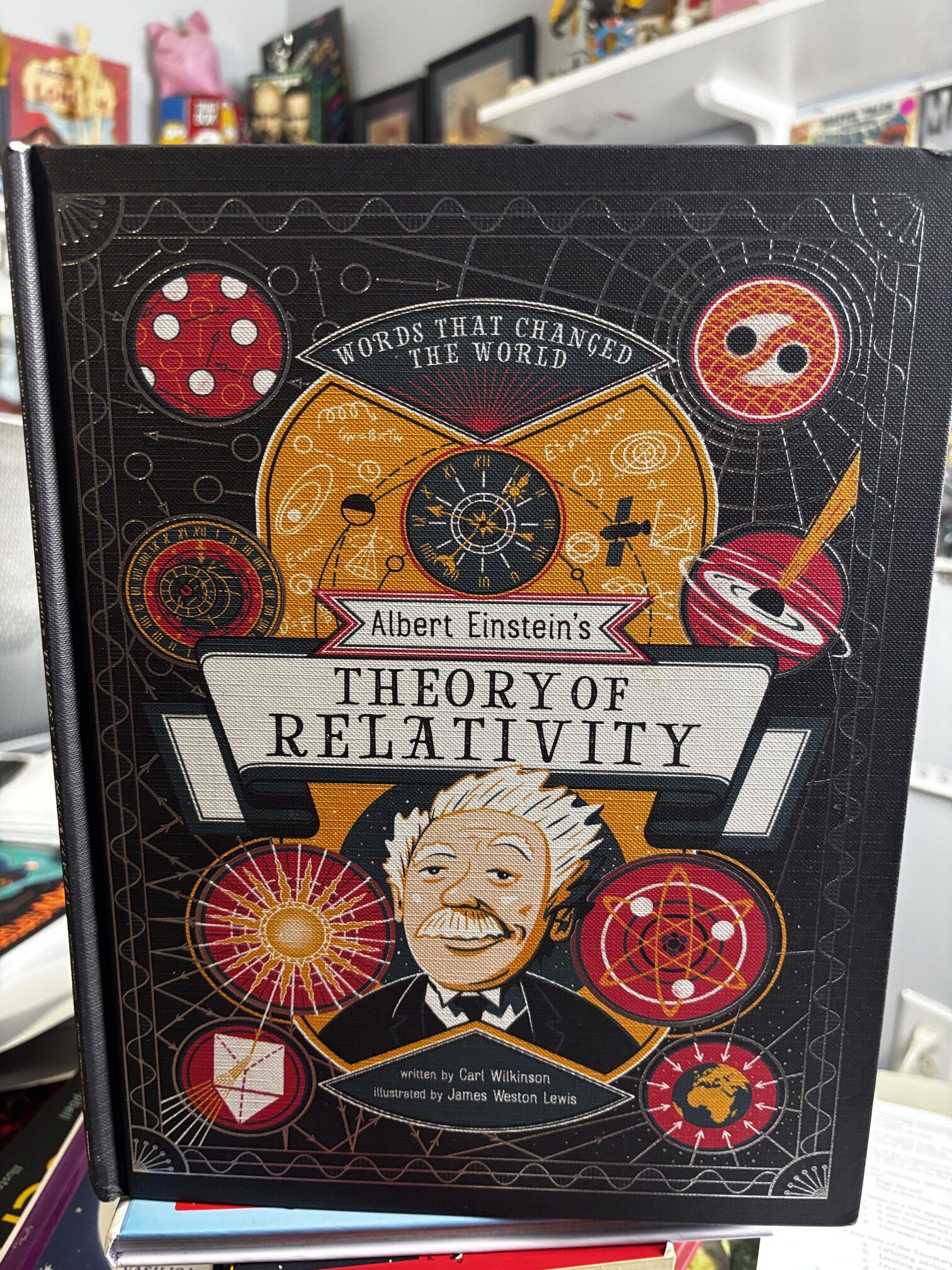
From the vault of: Will kids actually read it? That certainly depends on the age, but the book does a lot to attract readers to it. Its cover is cloth-wrapped cardboard with bright graphics. The book isn’t inlaid, but the fabric on its back and front produces the same effect. You want to touch the book. The graphics are curious and make more sense once you’ve seen the inside pages, like the beam of light that looks like it’s going through Saturn. It’s not Saturn, and those aren’t its rings.
The illustration in question is on page 57 too. It’s what a black hole probably looks like. Einstein proposed the idea and a physicist, Karl Schwarzschild, saw the opportunities and ideas in his theory. The accompanying page of text to that illustration makes black holes and the maelstrom of chaos happening near them understandable. I am in no way ready to teach AP-level science, much less on-level science. However, I was able to understand black holes just a little bit more thoroughly, as well as its relationship to the singularity and event horizon. Most importantly, Words That Changed the World made the very complex, curious, and reduces its intimidation factor.
The book only spends two pages on Albert Einstein as a person. Young audiences, heck, audiences of any age might not realize how revolutionary Einstein was in his theories. The way that scientists in his day viewed gravity, time, space, light and relativity were mainly shaped by Sir Isaac Newton. Words That Changed the World spends a sixth of the book letting readers know what people knew, thought and believed back then. That’s important because in some cases Einstein’s Theory of Relativity changed how scientists treated certain subjects.
Albert Einstein’s Theory of Relativity explains the tentpole accomplishment in Einstein’s research in a way that young readers can understand. It will probably take them more than one time reading the paragraphs, but it’s understandable. They probably won’t be able to build their own theorem of how to expand the shape of the universe, but they’ll be curious and have greater insight into it. Again, this book is taking probably the most complex idea that the average person knows of, and trying to explain it using paragraphs, blurbs and illustrations.
This isn’t an illustrated book you can read quickly. The vocabulary is written at an upper-elementary school level, which is important towards the book being understood. However, just because the book is written at a level fifth graders can understand doesn’t mean you can read it without thinking about the content. There is some space between the paragraphs and illustrations. Sometimes the content is presented on the graphics acting like a background. At other times they’re more tightly arranged so that the full-page illustrations can stand by themselves to demonstrate the scientific principle. This is done when it’s talking about the bending of light, the shape of the universe or the affect of light going through a black hole.
The other day my otherwise non-scientific son came home and was prattling on about a set of twins. One of them stayed on Earth while the other one went into outer space on a rocket. When the one who went into space returned it was hundreds of years later, but they’d only aged by a couple of years. The 12 year-old version of me grinned because I knew I had said the same story to my parents. I told my son that this had to do with time travel and was a theory proposed by Albert Einstein. At that moment I couldn’t recall the name of this theory, but I knew that I had just read about it in Words That Changed the World: Albert Einstein’s Theory of Relativity. It’s commonly called The Twin Paradox and is on page 28 and 29. The premise of this theory deals with time and how it slows down the faster that you go.
I mention that story to demonstrate how immeasurable it is to share the concepts in the book. Kids are already curious about Einstein’s Theory of Relativity, even if they don’t know anything about it. They simply don’t know the questions that they need to ask. Now just imagine that they’re shown the door that can illuminate the ideas and theories that lead to those questions. Words That Changed the World: Albert Einstein’s Theory of Relativity is that book. It’s that book, if readers are ready to experience it.
Words That Changed the World, Albert Einstein’s Theory of Relativity is by Carl Wilkinson with illustrations by James Weston Lewis and is available on Fox Chapel Publishing Company.
There are affiliate links in this post.


 Facebook
 Twitter
 Youtube
