Tee Time on the Moon, an illustrated book with eyes on a bigger prize

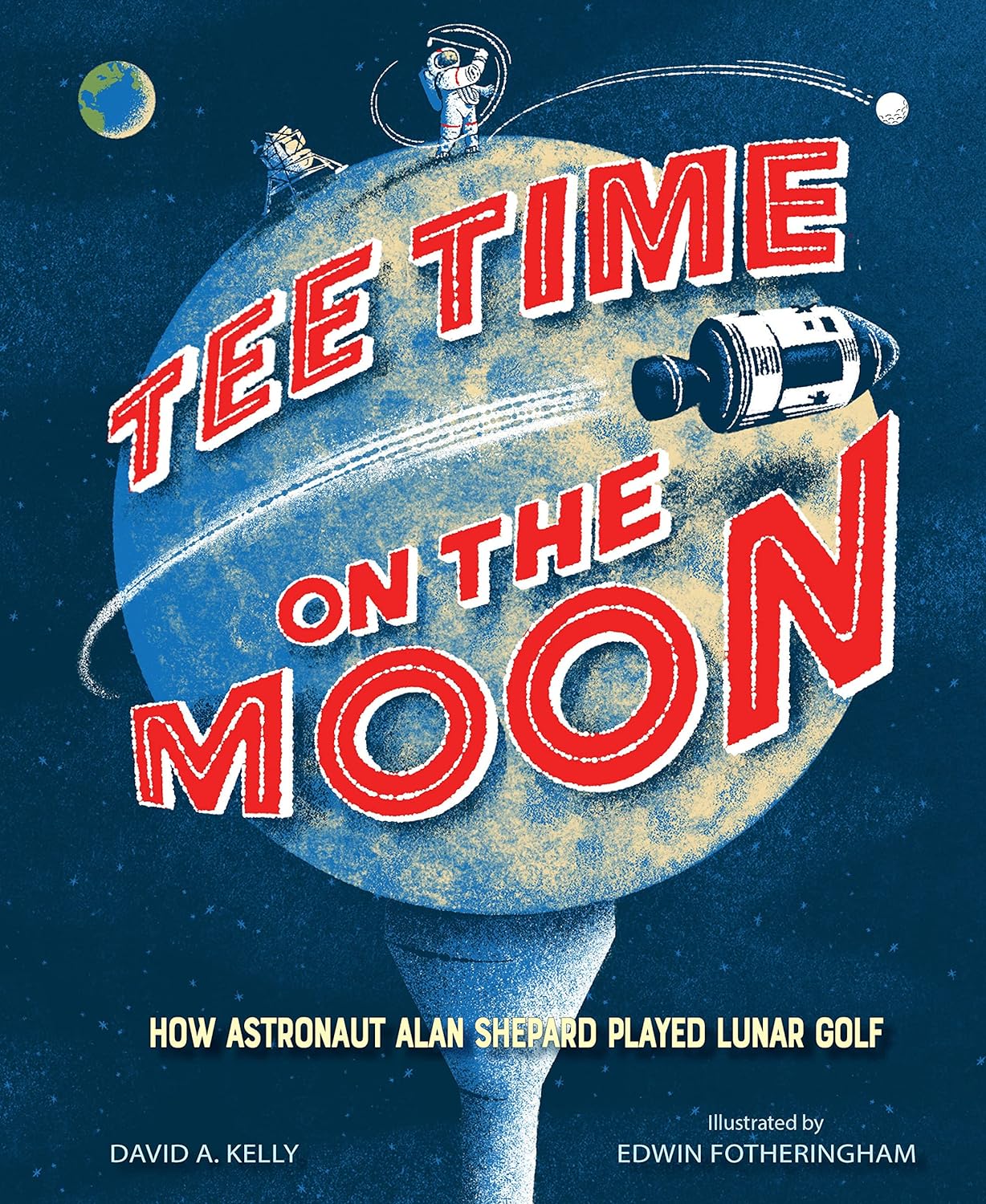
At times, science should be silly, especially if your audience is young and needs to look at things from a different angle. This is the angle that asks questions you’ve never thought about. It’s the sly questioning of whether or not there’s a rhinoceros in the room or a STEM-based story about the time an astronaut played golf on the moon. Tee Time on the Moon is an illustrated book aimed at early to mid-elementary school audiences, but whose curious nature will lend itself to those slightly younger, in addition to older than that. This is due to the left-field thinking that kids would have as to playing golf on the moon. However, the book’s layout also lends itself to welcoming young readers who might be intimidated by the story or the text that they see as out of this world.

Tee Time on the Moon is the story of Alan Shepard and his covert mission (with the help of NASA engineers) to play golf on the moon during the Apollo 14 landing.
Golf, with a slice of the moon, or vice versa

Beulah has a Hunch!, bygone innovations and their unlikely shepherd

Oh Beulah, you always have a hunch. When I read to younger elementary school audiences I love books like Beulah has a Hunch! Inside the Colorful Mind of Master Inventor Beulah Louise Henry, and so do those young audiences. It’s a real story and is one of the first instances of a non-fiction illustrated book that pre-k and early elementary will experience, and we do love some non-fiction. However, non-fiction is only as good as its enjoyment to those elementary ages. This is where the illustrations; combined with the zippy vibe of the book make Beulah has a Hunch! a fun time that won’t tax their time and just might inspire their imagination.

Beulah has a Hunch! is approachable, non-fiction STEM about an inventor that most people haven’t heard of who revolutionized the way kids play and how 1920’s ladies presented themselves.

Lady Edison for the win

The Skull, all bones that classically crackle with dread for lower elementary

Emerging readers want a sense of mystery. They want dark tales that are just enough to make them imagine what goes bump in the night, before squinting at them just enough to let them know that everything is fine. It’s the aura of a book that has age-appropriate dread or genuine curiosity. This allows their young imagination to fill in the blanks, which can be infinitely scarier than the text that they’re reading. The Skull is a perfect example of the feeling that kids want, and in many cases need. Aside from the title which inspires creepy questions in its own right, the book’s cover has a little girl hiding behind a big tree that’s been dusted with snow as she’s holding a skull. The background light is a soft pink that’s happening just around the sunset golden hour and it’s a place that you want to be.

The Skull is a perfect example of less-is-more, crafting a big modern classic story out of a simple premise about a runaway girl and a disembodied skull.
The Skull, Resistance is futile

Ludwig and the Rhinoceros, I Kant escape how clever this book is

After reading Ludwig and the Rhinoceros audiences, those young readers who were most likely having it read to them might have some questions, and that’s okay. As a teacher, and as a parent, unless it’s 9:00 and time for them to go to bed, I love questions. However, Ludwig and the Rhinoceros is an illustrated book, a brightly illustrated one at that, about Ludwig, a young boy and his imaginary large mammal friend. Elementary ages have seen books on imaginary friends before, what makes Ludwig and the Rhinoceros so much fun, in addition to feeling like a classic illustrated book that you’ve seen in your youth, is that it takes its talking points from a real-life person.

Ludwig and the Rhinoceros is a great and timeless, illustrated book. Ludwig and the Rhinoceros is a child’s first primer on critical thought. Both of these statements can coexist.
Great illustrated book/primer on critical thought-it’s all good

How It Happened! Gum, infectious non-fiction for ages 8-12

Children’s non-fiction book are useless unless they are read by children. It can be a great book all day long, but if younger readers don’t jump in the pool it’s merely an exercise in publishing. How It Happened! is a series of non-fiction books created by WonderLap Group. They take a common subject that kids are interested and give it the “Nat Geo Kids” treatment. That’s the way in which books look engaging to those elementary ages by offering up colored pages, a wide variety of illustrations and photographs, big print and text that takes their hands and makes reading fun.

How It Happened! Gum is an infectious, hard to put down non-fiction that sucks in ages 8-12 who think that they don’t like to read.

Elementary school kids, resistance is futile

How Old Is A Whale? soft, story-driven STEM on age for those 6 and up

Lily Murray got the memo. That’s the memo that states that the best way to get reluctant readers is to ask a question. How Old Is A Whale? Animal Life Spans From the Mayfly to the Immortal Jellyfish starts with a question that kids might never have asked, but asks it anyway. It’s the same Pavlovian instinct that kicks in when someone gently tosses a ball at you. You don’t actively want to catch or throw something, but you’ll catch the ball. How Old Is A Whale? I don’t know. I don’t care, I’ve never thought about it, but now that the book has asked me, I’m curious. A whale must have an interesting age scale because the book has thrown the question my way, so let’s see.

How Old is a Whale? asks the question that every elementary kids poses, plus dozens of other age-related ones on animals of all sizes.
Ask the question, you know that you want to

Please Don’t Bite Me!, smart text and timeless art serves up insects right

There are some books and some publishers that are impossible to resist for elementary school readers. These are the types of books that operate like a friendly, education-based Venus Flytrap. Kids will open the book to any page, be curious or entertained about what they see, and then thumb forward or backward to dig into more of the book. The book’s title, Please Don’t Bite Me! also entices kids to open it up. Instead of asking a question, it posits something in the form of a statement. What could be biting me? It’ll probably hurt, I sure hope this thing doesn’t bite me. Is this biting thing something that’s poisonous?

Please Don’t Bite Me! is a brilliant combination of enticing, timeless visuals with non-fiction text that engages ages 7-10, without grossing them out or dumbing it down.
Nature is timeless, the art is classic

Meet the Megafauna!, massive gatefolds with big critters

The biggest and smallest are the population of most elementary school essays. Meet the Megafauna! is the sort of illustrated book that feeds the soul of elementary school students that attracted to extremes. Most of the time it will be boys who want to read about the biggest, extinct creature and then proceed to do a three-minute report on them to class. There are other ways for educators to use Meet the Megafauna!, but they do require a bit more panache.    

Meet the Megafauna! uses great art and gatefolds to remind elementary ages that big creatures are cool, they don’t have to be dinosaurs and can have relatives among us today.
Big animals are cool and don’t have to be dinosaurs to qualify
Copy Protected by Chetan's WP-Copyprotect.