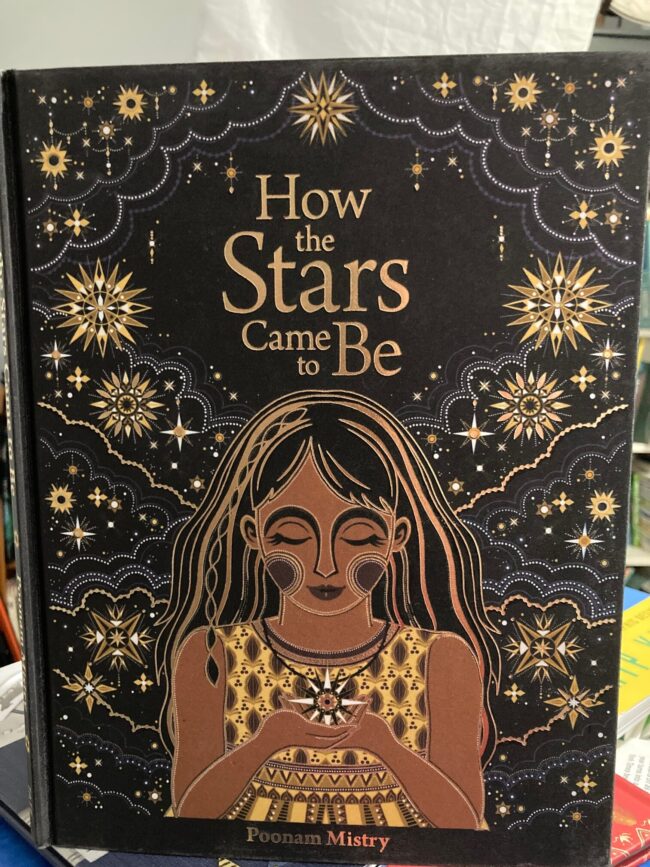
How the Stars Came to Be: Deluxe Edition, a lush, statement folk story

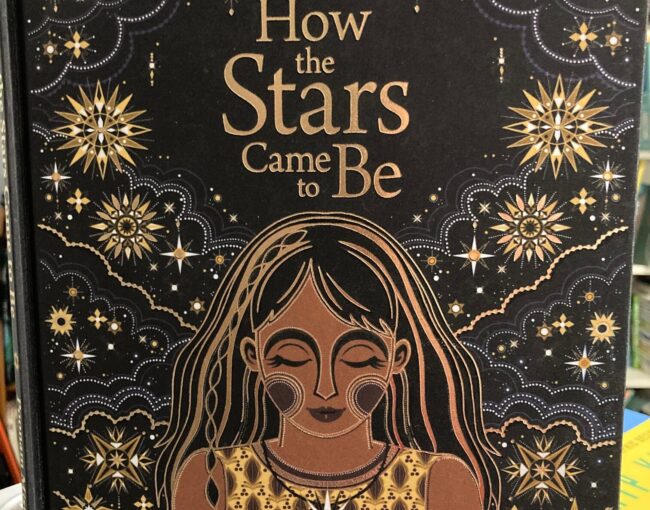
Folk stories shouldn’t have an age ceiling. Most of the folk tales that I’ve encountered have enough details in them to merit a feature-length movie. The really great ones can also be distilled into simple stories that are short enough, in that package, to be enjoyed by young audiences. How the Stars Came to Be Deluxe Edition, is an illustrated fable book that feels like it belongs in your hand. It’s a beautifully illustrated book whose regal impression is felt from the moment that you lay eyes on it. The front and back of the book have gold inlays where some of the stars in the sky are, in addition to the main character’s jewels and hair.

How the Stars Came to Be: Deluxe Edition is a folk story about the stars with detailed art that speaks to everyone in a museum quality manner.
Its a fine line between art and book with this one

Great Battles for Boys, fabulous non-fiction for ages 8 and up

But what about girls?, I can hear that being asked now. I’m casting a wide net that’ll describe a majority of boys, but not all boys. I’ll cast the same wide net and say that a series of emerging reader books on unicorns or kittens will be a big hit with girl readers in second grade. Whenever I teach ELA and I have to attribute one trait to a group there are always a couple who will say, “But, I….”, and yes, you might be the exception to that. Great Battles for Boys is a series of books that hits the reluctant reader boy on the head in an enjoyable and historical way.

Great Battles For Boys is a series of non-fiction books that are concisely written in a way that elementary school readers will immediately be attracted to.
Boys, girls, non-fiction or kidlit fans unite

Do You Know Rocket Science?, go-to, fun STEM for pre-k

From its title, Do You Know Rocket Science? could be confused with something from the What Is or Who Was from the Who HQ authored series of books. While that series is awesome, they’re for older readers, which is somewhat ironic given the subject matter of rocket science. Instead, Do You Know Rocket Science? is actually a book about rocket science, that’s presented on a level that pre-k through first, as well as, their parents, will understand and enjoy. It’s from Chris Ferrie, an author who we’ve written about on a couple of occasions that has a knack for turning science and STEM into something that kids want to know about.

Do You Know Rocket Science? is a Level 1 book for beginning readers that sets up a potentially complex idea in a manner that ages four through six will enjoy.
It’s OK if you and the young reader learn this together

Quest Kids and the Dragon Pants of Gold, kids love this cloth

Xerox and Coca-Cola are brand names that have become synonymous with their product. Cola, soda, or ‘make a copy’ are their siblings that are hiding in plain sight. Likewise, books that are closely associated with their contemporaries are often grouped together, for example, it’s like Harry Potter, Wimpy Kid, or Dog Man. For young readers of a certain age or period of their life, Wimpy Kid, and the world that surrounds him, represent their go-to entertainment. However, Wimpy Kid, when used in those instances is an adjective and not a noun. Quest Kids and the Dragon Pants of Gold is a great example of that being used as an adjective. It follows the cartoon and text format to an extent; but has aspects that allow the book to be embraced by readers who are younger, as well as, reeling in those reluctant readers.

Quest Kids and the Dragon Pants of Gold is mglit that’s cut from the wimpy cloth, but it’s bigger, more entertaining and fun for grades 5 and up.
It is Ok to be compared to something else and still be awesome

How to Send a Hug, it’s sweet but feels about 20 years too late

Don Quixote putting a stamp on the windmill. I mentioned that metaphor to my wife and she gave me the look that basically said ‘what the heck am I rambling about?’. I get that sometimes. How to Send a Hug is a very cute illustrated book that seems like the sibling to A Penny’s Worth. Unlike that book, the MacGuffin in How to Send a Hug is a letter, and it’s not the letter Q. This is the postal service, as in I have to send this eBay package to its buyer-so I’ll see you in two hours. I know, I should buy a scale here and print my own postage, but back to the book!

How to Send a Hug is a sweet testament to giving and receiving letters in the mail, but its concept might be too close to the telegram for young readers.
The book and concept are cute, the subject matter might put some adults off

The Sun Is Late And So Is The Farmer, hello to a new classic

Quirky is an interesting adjective and depending on specifically how it’s used could mean subtle, but different things. The Sun Is Late And So Is The Farmer is a quirky story in all of the right ways. The book is aimed at those pre-k through second-grade kids, and because they’re most likely not reading this review I’ll call the book a word that could cause derision and mockery in those circles. This is a charming book. That sounds like a word that you’d use when you don’t know how to describe something, but you’re implying that it’s a cute book for babies.

The Sun Is Late And So Is The Farmer is a timeless classic of an illustrated book about adventure and friendship, in your backyard.
Say hello to a book that’ll never leave your library

I Can Explain, cartoon-inspired lunacy on bad habits that teach a lesson via laughter

When I was a kid I wouldn’t talk for a couple of hours because I liked to imagine that I had a finite amount of words that I could speak on a given day. And if I was to use up my words with something silly, then that would just be wasteful, and my parents wouldn’t have liked that, would they? I Can Explain is an illustrated book from that same vein of illogical thinking that makes perfect sense if you’re a kid.

I Can Explain is a surreal look at how kids (and people) illogically excuse bad habits. It’s done via laughter in a way that ages 5 and up will howl over.
Don’t try to explain, just enjoy

Moving Forward, non-fiction illustrated that’s uncomfortable and inspiring

Illustrated books have the capacity to move us emotionally, in addition to making us think. Non-fiction illustrated books are capable of doing that but have the added burden of being a true story. Personally, I think that’s because some students heard that illustrated books were meant exclusively for silly stories about growing up or softly teaching morals. Moving Forward is an illustrated book that does all of those things, except for the silly stories part. Instead of that, it uses action, speed, and adventure that’ll help bring in elementary-aged readers.

Moving Forward is a non-fiction illustrated book that blends, adventure, family, rage, justice and the passage of time into something that fifth-grade students can learn from.
History happened, have kids read about it
Copy Protected by Chetan's WP-Copyprotect.