Is Mac & Cheese too clever for its own good? Are there too many jokes per page for children to understand? Do elementary aged students know more than one cheese pun, and if they don’t, does it matter? My first reaction on Mac & Cheese: The Origin Story was one of sheer joy. It’s a pun-laden book with at least two grins or guffaws on each page. On about half of its pages the laugh-to-page count can increase to five. Illustrated books aren’t usually this funny. They’re normally more lesson based. Those books are still positively enjoyable, they simply aren’t funny. I realize that some might not consider puns to be a laugh-out-loud medium, but for others they’re the sweet spot in the relationship of jokes and all-age humor.
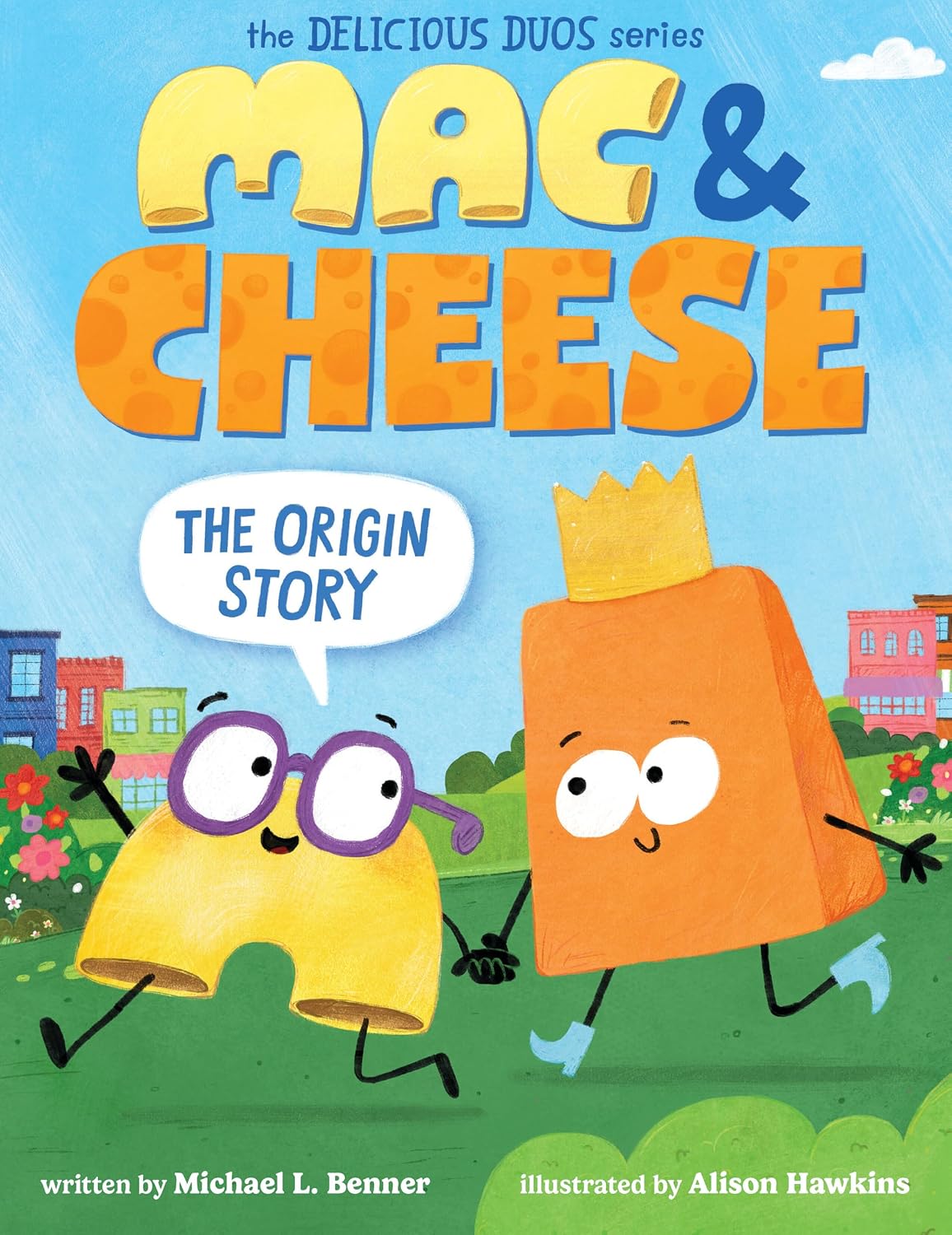
The sheer number of jokes, puns, and gags in The Delicious Duos Series, Mac & Cheese: The Origin Story is admirable. What’s even more amazing is that a very large percentage of them land. They’re either so cleverly written that you laugh audibly or are visually funny that you grin. Speaking of the illustrations, I knew that there was something I liked about them that I just couldn’t put my finger on, that was until my eldest son and I were at the dentist’s office.
He’s old enough to go there by himself, but I needed the car to get to work, which meant that I type (hopeful) witty comments about children’s literature. As I was thumbing through Mac and Cheese the 17-year-old said, “Looks like South Park.” He’s correct, but it requires a caveat.
Almost every page is completely loaded with background or ancillary illustrations. When Mac sails across the Sea of Snacks there are five anthropomorphic sweets on the beach or swimming in the water. The chocolate-covered pretzel says “Boooo!” to his pasta joke. The sprinkle cookie looks mildly amused, but they’re a sprinkle cookie, can you imagine it being anything other than that? Ditto the cupcake with pink frosting beside it. On the next page there are three vignettes of Mac being friendly to the locals, but they’re simply not getting his humor. There is a pack of very sour patch kids who chase him, but that’s the closest to friendly that he gets. On the next page he’s kicked out of the Desert of Dessert with a pink cake taunting the sheepish looking Mac by saying, “You want a piece of me?!?!?”
Mac and Cheese is about being yourself and finding your people. Mac and Cheese is a silly tale about food that will make (kids) laugh. Both of these statements are true. Which camp you find yourself in will depend on the person and ultimately doesn’t matter at all because both sides are correct.
Mac lives in Pastaland, but doesn’t fit in. He changes his semi-circular shape into a twisty noodle and he enjoys it for a little while, but it’s not his true shape. He’s half a circle, wears glasses, is irrepressible, enjoys singing and telling puns. Near the Desert of Dessert there’s a place called Quesoland. Cheese is new to the role of being a king and trying his best, but he really just wants one thing.
When Mac stumbles into Quesoland the residents are initially suspicious. Cheese sees a little bit of himself in the nomad pasta and the two become great friends. I rushed through the arc of the book because I didn’t want to reference any of the jokes or quips. Young readers won’t rush through it. They’ll look for details in each illustration, laugh at the zany characteristics or the exaggerated gesticulations of random cheese residents in Quesoland. Slightly older readers, the ones who get the puns or are learning sight words, will follow along to the book and remind themselves as to why it’s funny. The adult who is the read aloud person digging into Mac & Cheese will have fun saying the jokes for the first time. Optional: you can explain to those with a dazed expression that “aging cheese” is necessary, thus, when Cheese is frustrated and says that his job is doing just that, it’s funny.
Will kids get that? Some kids will certainly get it. Is it better to be the really funny book to 10% of the class and not worry about the 90%? Am I underestimating the intelligence of today’s elementary school audiences because I spend most of my days with classes of sullen teens? Am I frustrated that those sullen teens are unable to create a paragraph without having their hands held throughout the process? All of these things might be true. One undeniable thing about Mac & Cheese is that it will be entertaining to young audiences. All of them will understand the high points. Some of them will get the jokes quicker than others and will even parrot a couple of the jokes back to their parents, which is where the magic happens.
A Delicious Duo series, Mac & Cheese: The Origin Story is by Michael L. Benner with illustrations by Alison Hawkins and available on Orchard Books, an imprint of Scholastic Books.
There are affiliate links in this post.


 Facebook
 Twitter
 Youtube