We are big fans of the Nathan Hale’s Hazardous Tales book series. It’s the New York Times Bestselling series of non-fiction graphic novels that makes history fun. Nathan Hale’s Hazardous Tales: The Web of War is the 14th book in that series and the best one yet. All of his graphic novels are enjoyable on some level. Our only complaint with them as a whole was that their font was small. Fast forward to The Web of War, my glasses have a new prescription or this book operates on a higher plane that encourages my middle-aged eyes to lock in more and get lost in a book.
It’s actually the latter, which means that The Web of War will weave its magic on any audience that gives it a chance. The quality, creativity, dedicated research, enjoyment, critical thinking, and historical knowledge will dazzle audiences who already enjoy Nathan Hale’s books. It starts in the liner notes on the second page. This page is normally reserved for the author to thank those who helped their book journey earnestly. It’s the same here, but just slightly different, as Hale thanks four people, including Norm Macdonald. “The more I learn about this Hitler fellow, the less I care for him”, any chance to remember Macdonald’s unique, dry and time-consuming jokes are awesome. That quote is in the front of the book and baits the story as The Web of War commences.
The Web of War is not your typical graphic novel, and that’s saying a lot for a Hazardous Tales book. D-Day is the underlying story of the book, but there are many story strands that went into that battle on the shores of Normandy. The Web of War fully embraces these strands by spinning into a choose-your-story type narrative.
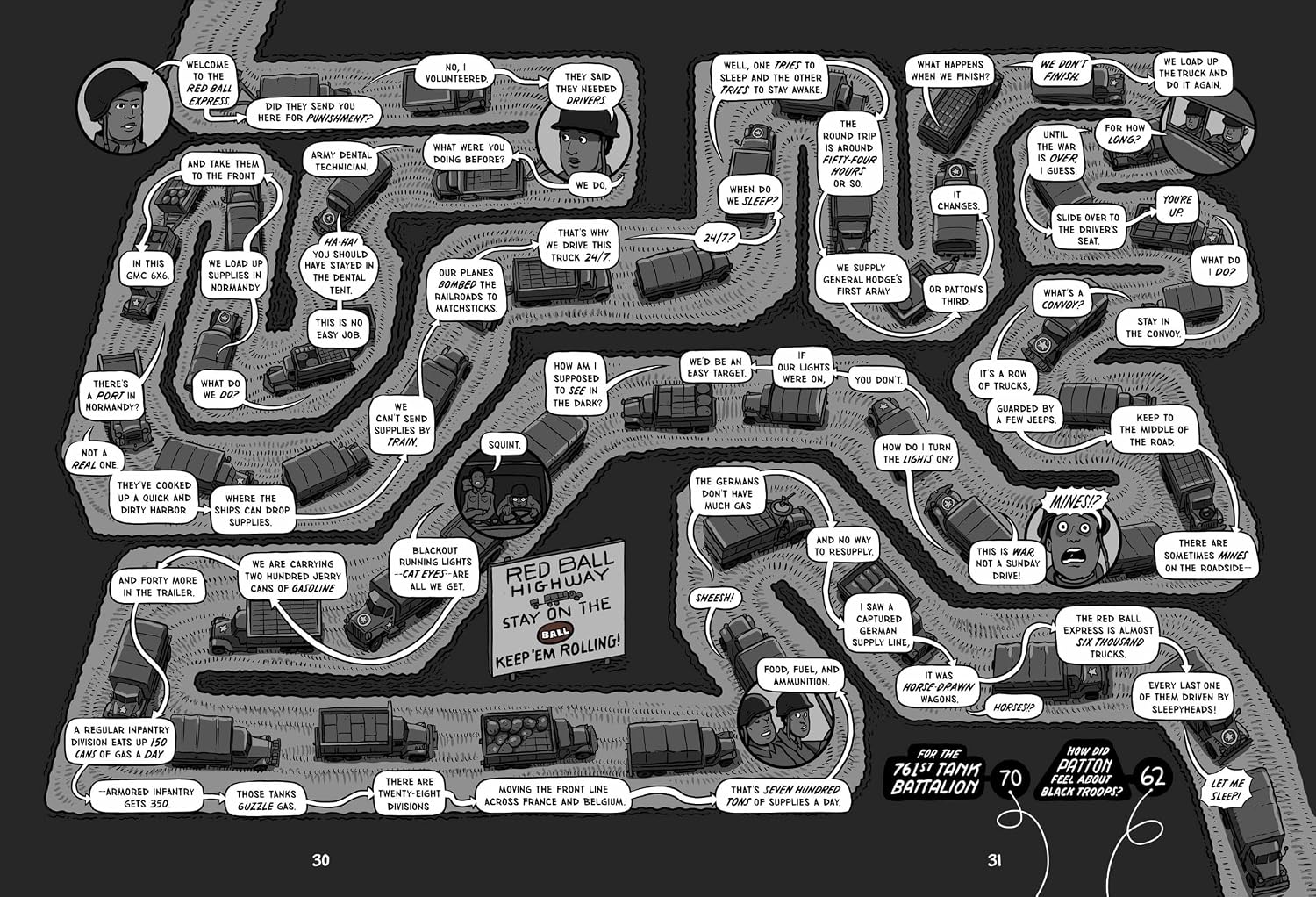
At about 15% into the book, its trio of narrators confront the storyteller (Nathan Hale, the American Revolutionary War spy) about the story being too confusing. Nathan Hale is that non-fiction person, as well as, the real name of the author/illustrator of the books. Hale (the character in the book) calls upon a spider friend of his to shrink them down to a minute size and encase them all on its web. Once on the web, the spider, in a very calm, reassuring voice, reminds them that war is impossibly complex. The spider creates seven distinct threads for the readers to follow. Each strand is a linear that explores Patton, Hemingway’s role in WW II, Hitler, the overall war, Black soldiers in WW II and more. This is where the choose-your-ending aspect comes into play.
I did not read The Web of War that way the first time. I read it in a linear fashion the first time, and then followed each story strand via the pages it directed me to, the second time. It’s enjoyable and easy to understand either way. The Web of War is more than that, it’s educational and will teach readers of any age multiple facts they didn’t know about WW II. Every page had at least one fact that I didn’t know about WW II, and that was mainly due to the fact that I taught middle school history.
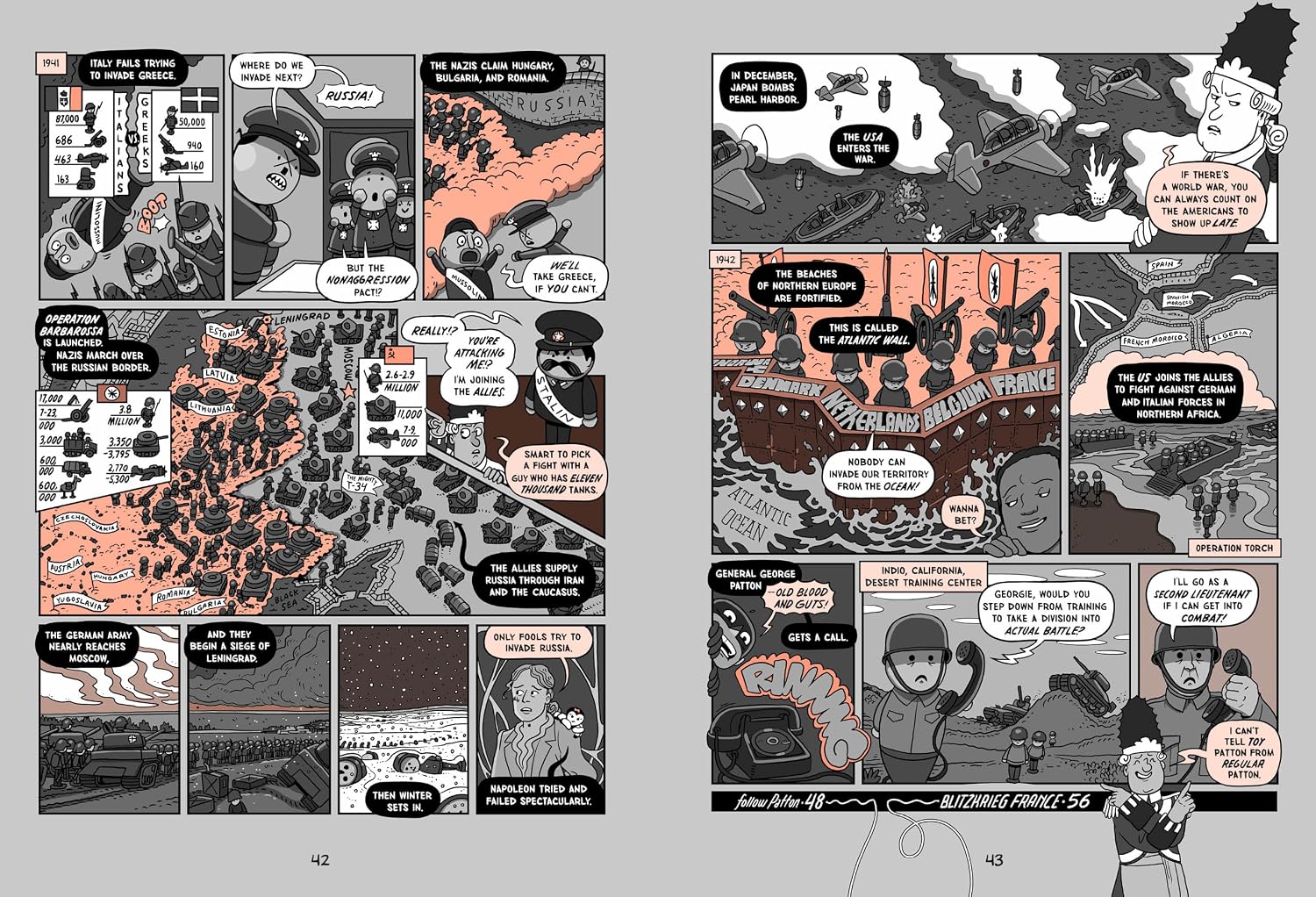
If it’s been a while since you took a history class, or barely paid attention to the teacher because you thought they were boring, read The Web of War. It asks those things you might’ve been thinking. The books details Hitler’s rise to power. The Night of Long Knives is presented in a two-page manner that you’ll never forget. For a historical book set in the era of WW II it’s remarkably frank in dealing with the Nazis and their mindset.
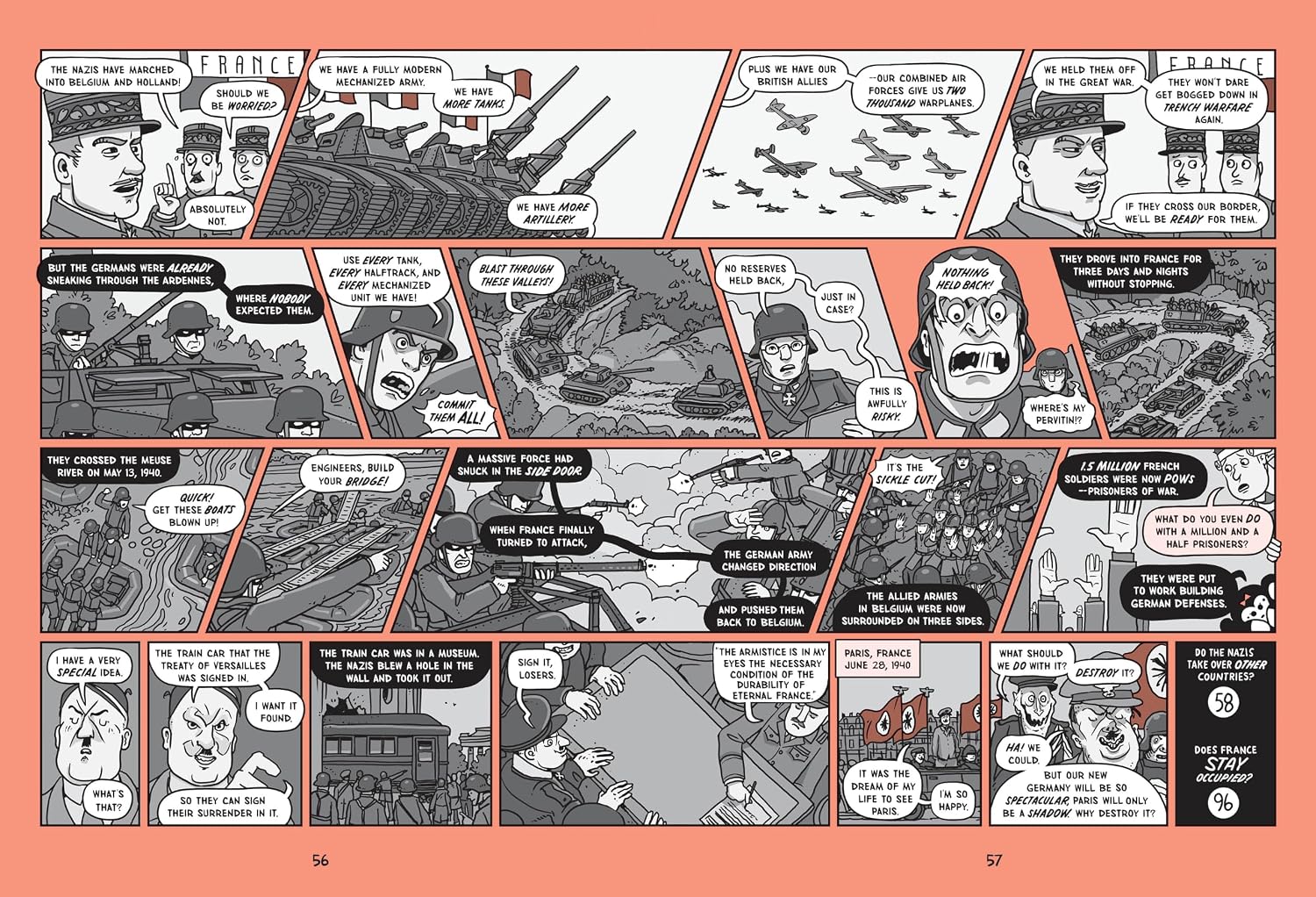
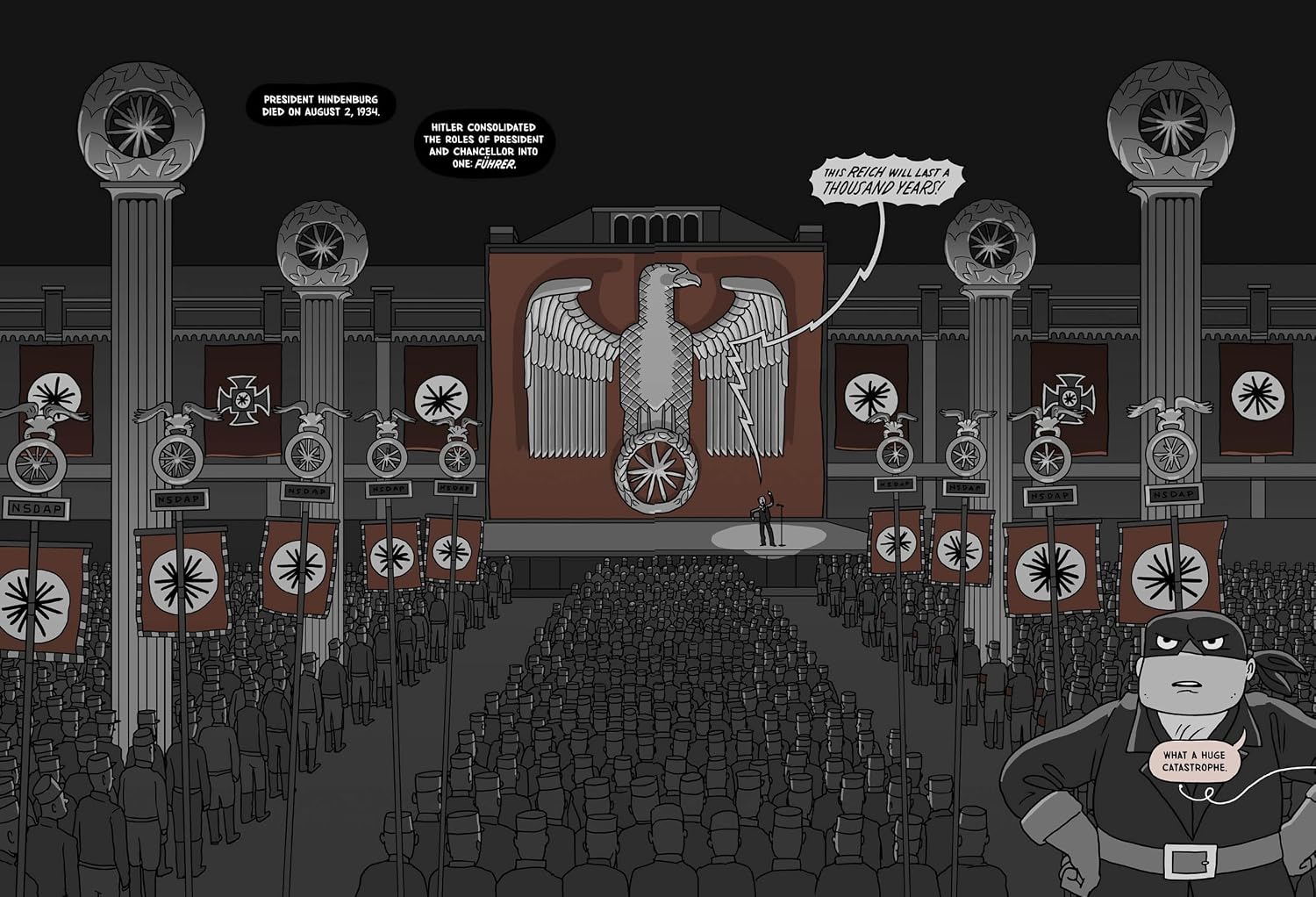
Having swastikas in a book as many times as needed to be historically accurate would be depressing and provide them press. That situation is addressed by our narrators who decide to use something that resembles an apostrophe for their logo. The sheer level is evil is illustrated by art that’s much larger, detailed and more vicious. When Hitler’s Nazi party got 12 seats, only 2.6% of the popular vote, they were laughed at. In the book, this is explained in two panels, with one panel showing a human head, but is attached to a neck leading to a much larger 12-legged beast. The beast is occupying a much larger, red panel beside it. At the end of this same page readers can see what happened at the next vote or see if the Farm Party would’ve started a war by going to the page it recommends.
This all sounds too complex to be enjoyable. It’s not. Once you’re in the book it’s fun. It presents facts in a way that are memorable, entertaining, and effortless. If casual fans of the Hazardous Tales series have checked out because it’s 13 books deep, they need to re-engage with them. The Web of War is so engrossing that it makes us want to re-read the 13 before this one.
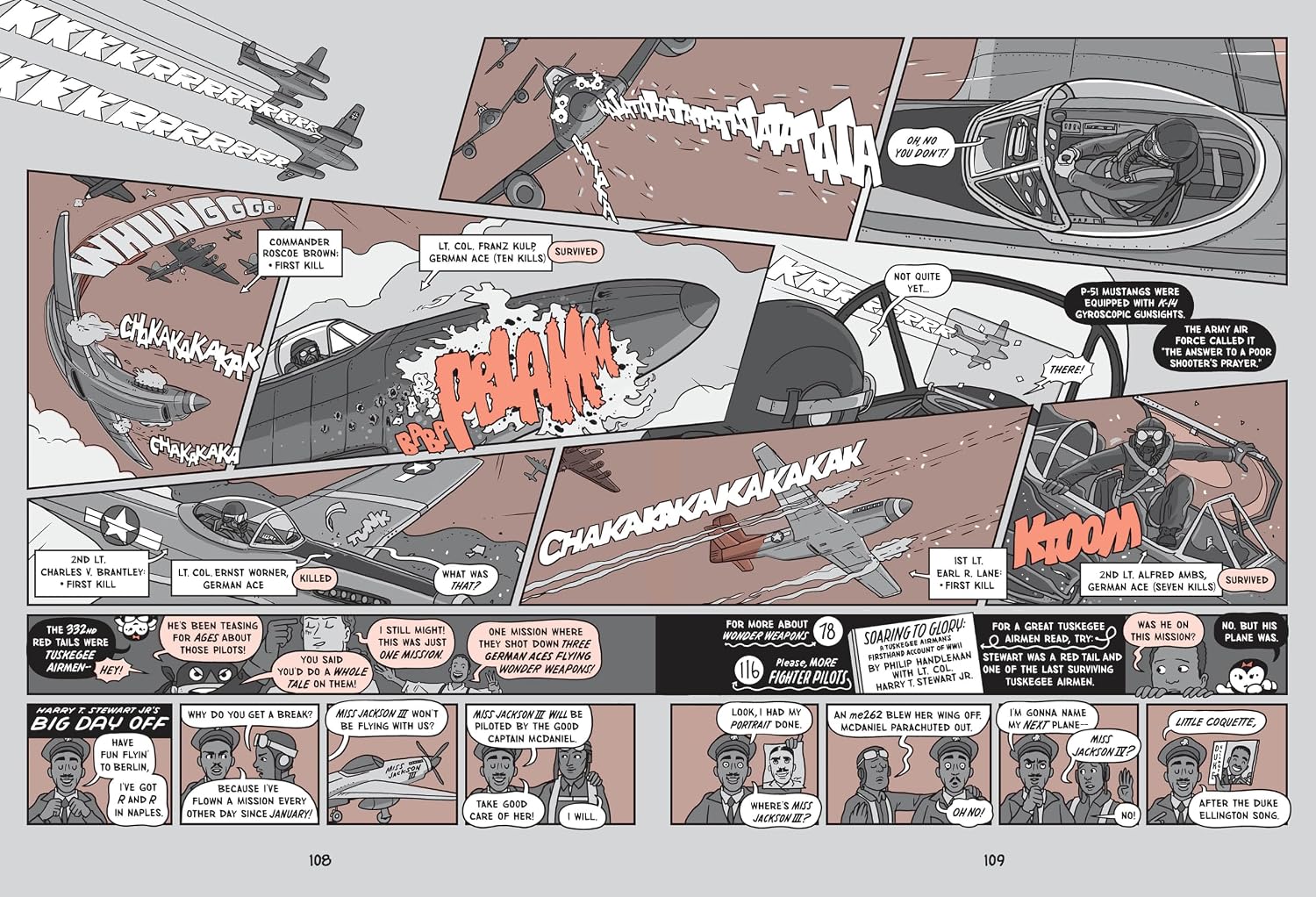
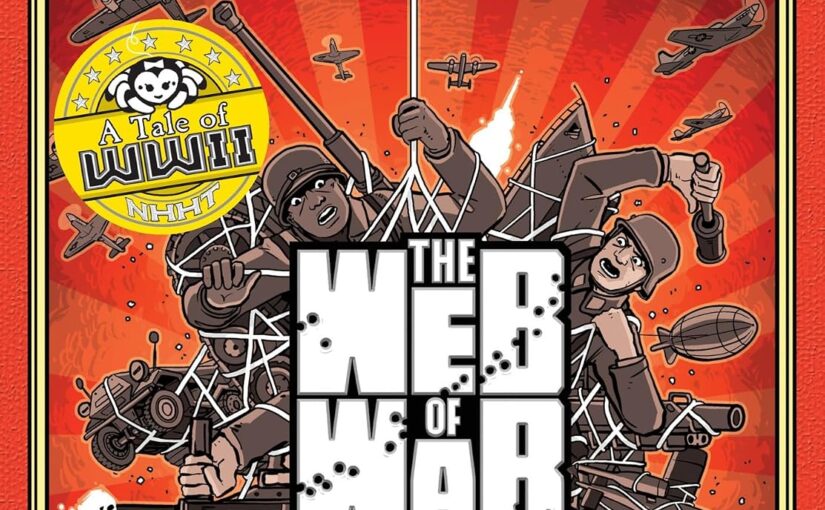
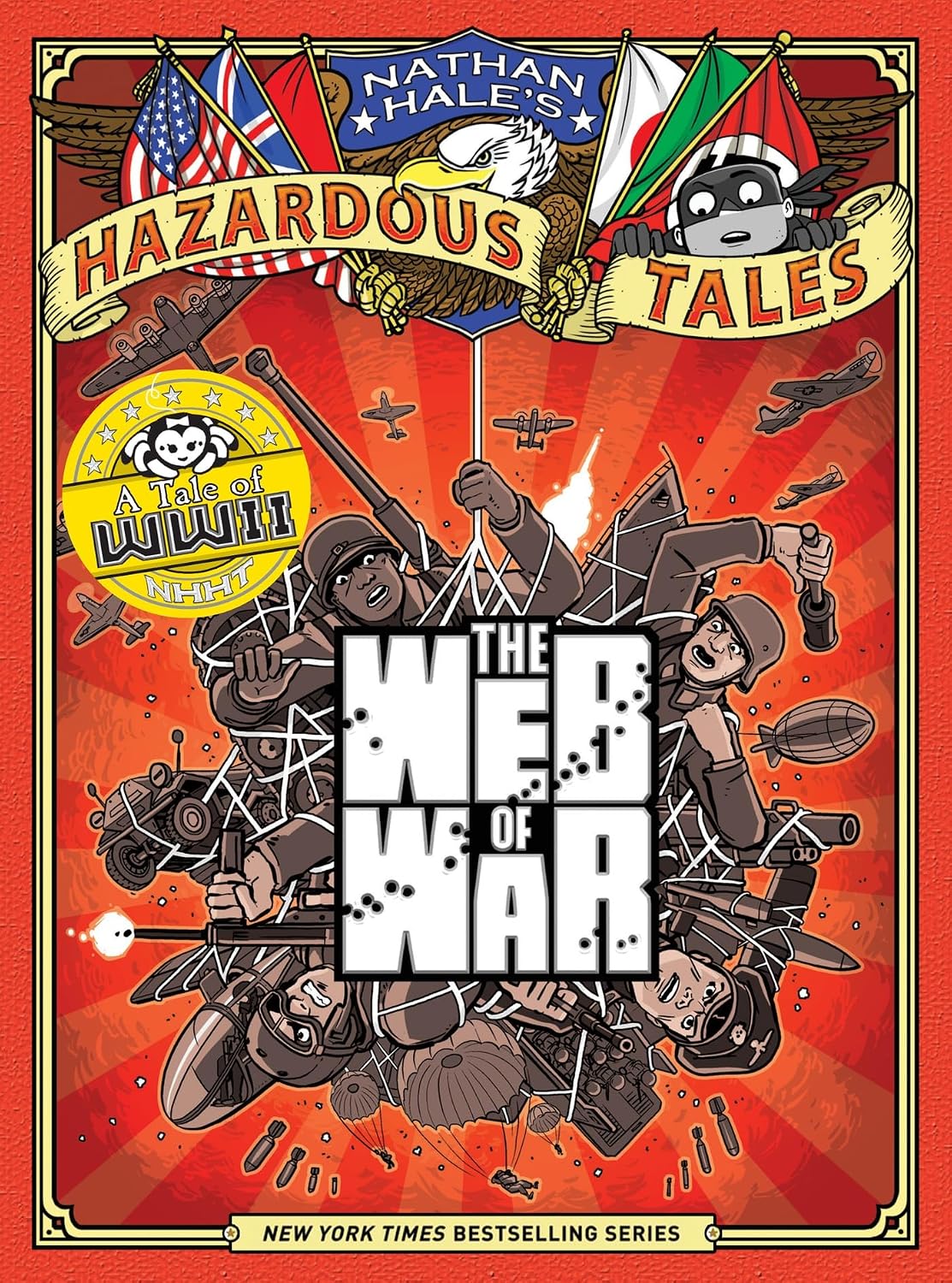
After you read the book it all makes sense. The various soldiers and their equipment are entangled in a web that’s being dangled from above. There is a physical sticker on its cover featuring a spider and “A Tale of WW II”. When you open the book, you’ll see a kaleidoscope of character names, key words, directional arrows, and rabbit holes that could be a pinball machine, maze or psychedelic poster for the world’s best progressive band whose name you can’t pronounce.
What readers might not initially realize is how deftly the book handles the truth, horror and reality of war. There were untold numbers of bad people, millions of people were killed; (unexpected) known figures were anti-Semitic; and the very worst of humanity was on display. The Web of War doesn’t water those aspects down. It acknowledges them, doesn’t trivialize the people or the actions, and wraps it all into a concrete story.
Hint: take your time reading the book. The panels are loaded with information that’s either in the text or a context clue in the illustrations. Some of the art is presented at a simpler level; some is more graphic or surreal. It’s a black-and-white graphic novel with accented shades of red to move the story or accentuate horrors or things of interest.
If it’s your first Hazardous Tales graphic novel, it’s unlike any book you’ve read before. Even the previous 13 Hazardous Tales books don’t read like other books. Their presentation and the manner in which the narrators cut into the story, genuinely helps the understanding of the plot, but might confuse people at first. So far, The Web of War is the magnum opus of Nathan Hale’s Hazardous Tales. This is a high water mark. It’s an example of how well the medium can educate, all the while entertaining and never taking its eyes off the prize of getting readers to learn to love reading.
Nathan Hale’s Hazardous Tales: The Web of War is by Nathan Hale and available on Abrams Fanfare, an imprint of Abrams Books.
There are affiliate links in this post.


 Facebook
 Twitter
 Youtube
