Welcome to the
1,000 Facts About Space
Blog Tour!

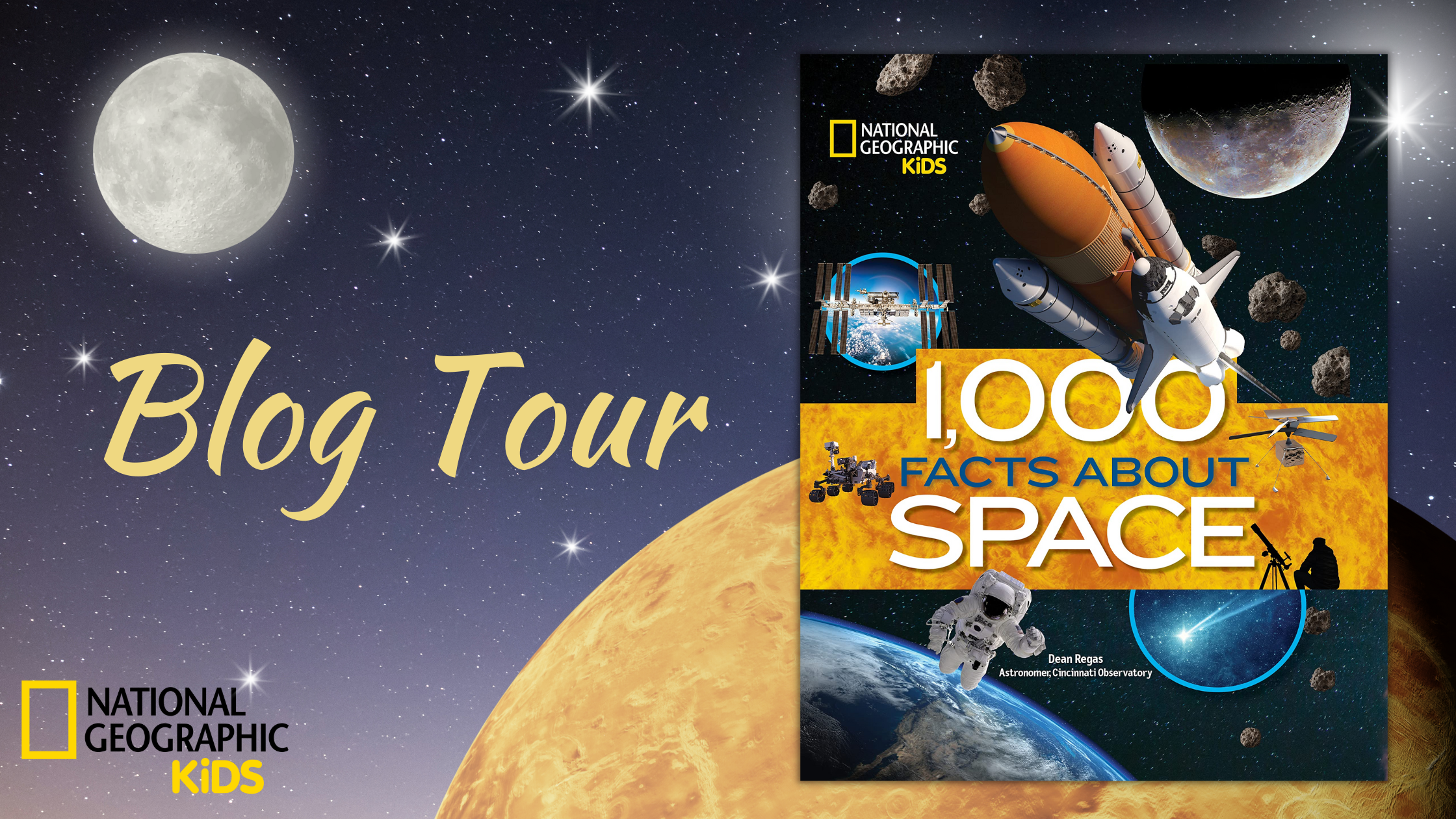
Get ready to blast off on an illuminating journey to the farthest reaches of the universe as we celebrate the release of the 1,000 Facts About Space (National Geographic Kids Books, ages 8-12). This week, five blogs across the web are featuring out-of-this world facts about mysterious black holes, daring space travel, groundbreaking missions, awe-inspiring stars and one of the giants of the solar system – Uranus! Looking to up your galactic IQ? Read on!
8 Facts About the “Ice Giant” – Uranus!
Uranus was the first planet discovered using a telescope. English astronomer William Herschel spotted it in 1781. Herschel wanted to name his planet after the King of England, George III. Other astronomers wanted to name it “Herschel.” Eventually a more traditional name from ancient mythology—Uranus—was selected.
- A day on Uranus is only 17 hours long, but it takes Uranus 84 years to complete one orbit around the sun.
- Uranus is much larger than Earth. It has four times the width, takes up 63 times more space, and weighs more than14 times the mass of our planet.
- Uranus is a gas giant like Jupiter and Saturn—you cannot stand on its surface. It is made almost entirely of hydrogen and helium gases.
- Uranus is tipped on its side, so it sometimes looks like a green-blue ball rolling around the sun.
- Astronomers recorded the coldest temperature of any planet in Uranus’s cloud tops. The temperature in the atmosphere in one area was minus 371°F.
- It is extremely rare, but people with exceptional eyesight can see Uranus with their naked eye. Everyone else needs a pair of binoculars or a telescope to spot it.
- Unlike other gas planets, Uranus appears to have few surface features. It does have storms and changing weather patterns, but the top gas layer almost always look like a hazy blue-green ball.
- Some of Uranus’s moons—such as Miranda, Ophelia, and Juliet—are named for characters from Shakespeare’s plays. Others, like Umbriel, Ariel, and Belinda, come from a poem by Alexander Pope, a 17th-century English writer.
If you’d like to learn
992 MORE facts about black holes, planets, astronomers, telescopes, space travel, pioneers of space travel, space weather and so much more, check out
1,000 Facts About Space by astronomer Dean Regas.
 Buy | Buy on IBookshop.org | Add to GoodReads
Did you know … that one of Saturn’s moons is so hollow it would float in water? That the largest known star is 3.69 billion times bigger than our sun? Or that Jupiter likely has diamonds floating in its clouds? Explore dazzling facts about the vast expanse of space, from glowing stars billions of light-years away to supermassive exploding supernovas to rockets thundering into the unknown. This comprehensive book takes you on a mind-blowing tour of our unbelievable universe and is full of fascinating facts on topics such as space exploration, our solar system and galaxy, and beyond.
Expert astronomer Dean Regas ― former host of PBS’s Star Gazers and astronomer of the Cincinnati Observatory ― takes you on an incredible tour of facts about each planet in our solar system, dwarf planets, our sun and other stars, exoplanets, comets, asteroids, galaxies, space travel, and so much more. Hundreds of stunning photographs bring the facts to life.
DEAN REGAS has been the astronomer for the Cincinnati Observatory since 2000. He is a renowned educator, author, national popularizer of astronomy, and an expert in observational astronomy.
From 2010–2019, Dean was the co-host of the PBS program Star Gazers. His books include Facts From Space!, 100 Things to See in the Night Sky, and 100 Things to See in the Night Sky, Expanded Edition. Dean is a contributing editor to Sky & Telescope magazine and a contributor to Astronomy magazine, where he won the 2008 Out-of-this-World Award for astronomy education. Dean has written more than 150 astronomy articles for the Cincinnati Enquirer, blogged for the Huffington Post, and is regularly featured on television and radio. Dean is a frequent guest on National Public Radio’s Science Friday and Here & Now. He also hosts an astronomy podcast with Anna Hehman called Looking Up. At the Cincinnati Observatory, Dean has developed his skills as a dynamic writer and public speaker who brings the complicated field of astronomy down to Earth for students of all ages. You can find him online at
https://www.cincinnatiobservatory.org/dean-regas/about-dean.
Additional Resources
For additional info on the wonders of outer space, check out the kid friendly games, articles and amazing images of our galaxy and beyond at National Geographic Kids’
Passport to Space. Educators, tap into to a wealth of resources focused on space exploration, including informative videos, articles and Kahoots, at NG Education’s
Resource Library.
GIVEAWAY
• One (1) winner will receive a hardcover of 1,000 Facts About Space
• US/Can only
• Ends 2/19 at 11:59 pm ET
• Enter via the Rafflecopter below
• Visit the other stops on the tour for more chances to win!
A Rafflecopter Giveaway
Blog Tour Schedule:
February 6th — From the Mixed-Up Files of Middle Grade Authors
February 7th — Imagination Soup
February 8th – Daddy Mojo
February 9th – YA Books Central
February 10th — Always in the Middle











 Facebook
 Twitter
 Youtube
