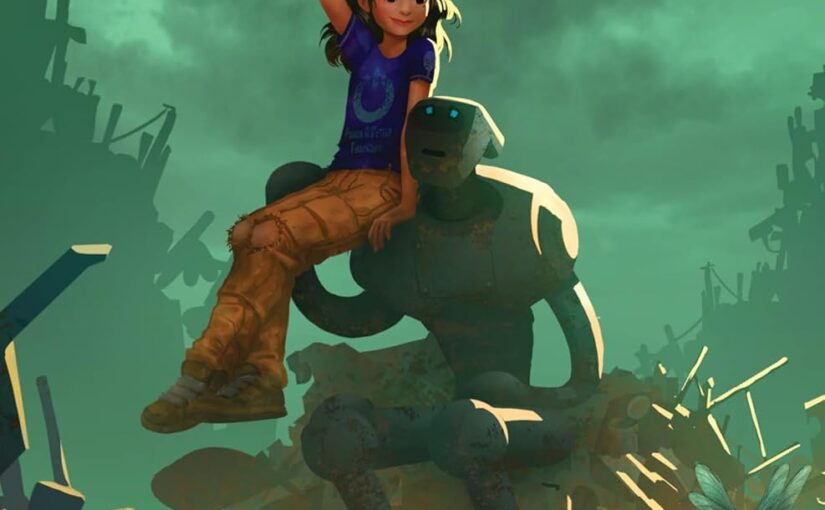
Say this about The Second Life of Snap: it knows its target. Older readers might look at its cover and draw parallels to The Iron Giant. They could alter their opinion after looking at the back cover and see that our heroine is accompanied by three other kids. The three of them are seated on some nondescript rubble of a not-too-distant society, while Zuzu is on Snap’s shoulders. The subtitle to the book is, A girl, A robot, A race for the future, so readers will know that it’s dystopian to an extent.
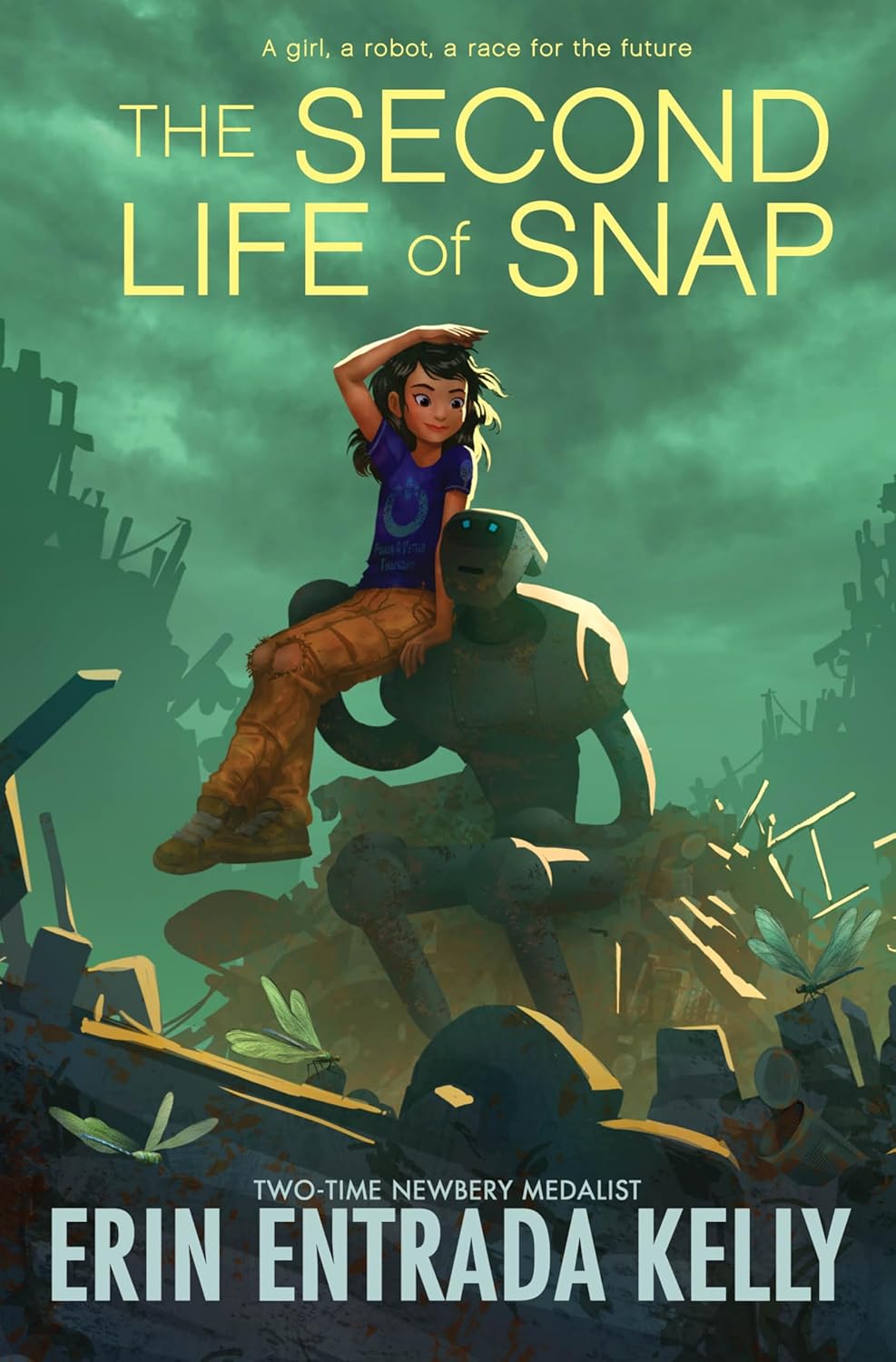
This gets us to The Second Life of Snap and how it knows where its bull’s eye is located. Readers will hear dystopian and unconsciously realize that the book is meant for upper-elementary and some middle school readers. The text is larger than middle school audiences are accustomed to. That larger text will signal to those older readers, “I’m your friend, I mean you no harm”. It says the same thing to younger readers via the illustration on the front cover.
It starts in a manner that provides enough intrigue to propel younger readers. The unknown back story is alluded to, and has a sprinkling of the main characters and their traits to humanize the story. I relate to that person. My best friend is like that, but I’m more like the other person. We were in a situation like that once. This is the set-up portion of the book where it’s attempting to thread the needle of uniqueness and commonality.
Because The Second Life of Snap is ultimately a book geared for upper-elementary school readers, it usually defers to the latter. Initially, the robot is given a very robotic name. One-G is a guardian robot. It’s been assigned to Suzanna, referred to Zuzu by her friends, as a means of watching over her and her friends. Zuzu is a big kid and doesn’t need a robot minder. Besides, the Valleycats, as the group refers to themselves, have things to do and having an overlord who records everything and can’t tell a lie would cramp their style.
One-G sees the kids doing something that their parents wouldn’t approve of, so they re-set it. The robot comes back online, but is 100% less robotic. The kids see that there are all sorts of clinical terms on the robot and pull four of the sequential letters out in order to provide its new name, Snap. The Valleycats are an optimistic bunch in a rather pessimistic time. The world they live in is made up of societal clicks, with everyone having to scavenge on some level. The Valleycats and their families live in the lower-most rung. There are lots of clues in the text, but the kids contemplate taking the robot apart and selling its pieces.
Snap ingrains itself into the friendship of the Valleycats. It starts to make jokes, yet retains the strength and durability that robots have over humans. The group is helping their community, and society could be making a comeback. The book is set in a desolate area where major storms can whip up with very little warning. To make matters more challenging, Snap’s battery can’t be recharged. As the group discover more things and have more fun, they always have to be aware of his battery life.
Readers in seventh grade will quickly know where the story is going and how it will most likely end. Readers in sixth grade will probably fall into the same camp. Those elementary school readers have found their jam with The Second Life of Snap. It interests boys as well as girls, which is saying something considering that the protagonist is a girl and that young age is picky with their literature. It has enough action, science-fiction fun and robot hijinks that young boys will forget they’re reading something. Avid fourth-grade readers will be able to dig into the book and read it with a little effort. Its reading level is before those other dystopian books that kids will eventually fall in to. For a narrow band of readers, The Second Life of Snap will be one of the first big kid books they read. It’s beyond a chapter book, before Harry Potter, and fits nicely into someone’s step ladder book journey if they’re seven to 11 years old.
The Second Life of Snap is by Erin Entrada Kelly and is available on Greenwillow Books, an imprint of HarperCollins Publishers.
There are affiliate links in this post.


 Facebook
 Twitter
 Youtube